
How the Robot Umpire Changes the Game: A Beginner Guide to the KBO ABS System

Fans walking into Suwon KT Wiz Park or cheering for the SSG Landers this season are witnessing a historic shift in professional sports. The Korea Baseball Organization (KBO) has officially moved into the future by becoming the first major professional league to fully implement the Automated Ball-Strike System, commonly known as the ABS. While the game looks the same from the bleachers, the technology behind every pitch has fundamentally changed how strikes are called and how teams compete.

The Mechanics of the “Robot Umpire”

For a beginner fan, the term “Robot Umpire” might conjure images of a mechanical figure standing behind home plate. In reality, the ABS is a sophisticated network of technology that operates invisibly. The system relies on multiple high-speed, high-resolution cameras positioned around the stadium. These cameras track the baseball in three dimensions from the moment it leaves the pitcher’s hand until it crosses the catcher’s glove.

The most impressive part of the system is how it handles the strike zone. In the past, the strike zone was often a static box that stayed the same regardless of who was hitting. With the ABS, the system creates a personalized strike zone for every player. By measuring a batter’s height and stance, the computer calculates a zone that is mathematically fair for that specific individual. This ensures that a tall slugger and a shorter leadoff hitter are treated with the same level of precision.

The Communication Loop: Human and Machine

Despite the high-tech tracking, human umpires have not disappeared from the field. Their role has simply evolved. Once the cameras and the computer determine whether a pitch is a strike or a ball, that data is instantly processed and sent through a communication loop.

The home plate umpire wears a specialized earpiece. Within a fraction of a second, a voice in the earpiece relays the call. The human umpire then makes the physical signal—the classic punch-out for a strike or the spread arms for a ball. This hybrid approach keeps the traditional rhythm and atmosphere of baseball intact while ensuring the data driving the game is objective.

Why “Catcher Framing” is Disappearing

One of the biggest impacts for new fans to understand is the decline of a skill called “framing.” For decades, catchers were praised for their ability to subtly move their gloves toward the center of the zone after catching a ball. The goal was to trick the human eye of the umpire into calling a “ball” a “strike.”

Under the ABS, framing no longer works. Since the computer tracks the ball as it passes through the zone, it does not matter where the catcher’s glove ends up. This change has led to a more predictable game where pitchers are rewarded for hitting their targets rather than relying on a catcher’s sleight of hand. For a new fan, this makes the game much easier to follow, as the calls are based on physics rather than persuasion.

Impact on Local Teams: KT Wiz and SSG Landers

In the Gyeonggi and Incheon regions, teams like the KT Wiz and SSG Landers are adjusting their strategies to fit this new reality. Pitchers who specialize in “painting the corners” of the zone are finding that the ABS is incredibly consistent. Unlike human umpires, who might have a “tight” or “loose” zone depending on the inning or the weather, the ABS remains the same from the first pitch to the last.

This consistency helps beginners understand the game better. If you see a pitch on the broadcast tracker that clips the very edge of the zone, it will be called a strike every single time. There is no longer the confusion of seeing the same pitch called differently in the ninth inning than it was in the first. For those interested in how these rules impact the final results, it is helpful to look at how official results override broadcast results in various sporting contexts to ensure accuracy.

Why Some Calls Look “Wrong” from the Stands

It is common for fans at Suwon KT Wiz Park to boo a strike call that looked like it was in the dirt or outside. This happens because the ABS tracks the ball as it passes through a three-dimensional plate. Sometimes, a “breaking ball” like a curveball can clip the very top or back of the strike zone before landing low in the catcher’s mitt.

To the naked eye, it looks like a low ball. To the ABS cameras, it is a strike because it touched the designated zone at some point during its flight. Understanding this helps new fans appreciate the complexity of pitching and why the “Robot Umpire” is actually more accurate than the human perspective from a seat in the stands.

The Global Significance of the KBO

The KBO’s move to the ABS is a massive experiment that the rest of the world, including Major League Baseball in the United States, is watching closely. By removing the “human element” from the most controversial part of the game, the KBO is prioritizing fairness and transparency.

This technological shift is part of a broader trend where 데이터 지연과 코트사이딩-정보 확보를 위한 경주 (the race for information and data accuracy) is becoming the central focus of modern sports. For the fans in Korea, being the first to experience this means they are at the forefront of a global revolution in how we watch and understand sports.

As the season progresses, the ABS will continue to be a talking point. Whether you are a die-hard KT Wiz supporter or just starting to follow the KBO, the “Robot Umpire” ensures that the game you are watching is decided by the players’ skills and the flight of the ball, exactly as the rules intended.

Protecting Your Personal Data as Sports Coverage Moves Online

For decades, following a sports team in the Gyeonggi-do region was a matter of ritualistic simplicity: you turned on the television, navigated to a terrestrial or cable sports channel, and the match was there. However, as we move through the 2026 season, that ritual has been fundamentally disrupted. The migration of the KBO (Korea Baseball Organization) and K League broadcasting rights to exclusive paid digital platforms like TVING and Coupang Play has moved the “stadium” from the living room television to the smartphone screen.

For the residents of Bucheon, this isn’t just a change in where they click; it is a profound shift in consumer behavior that carries new responsibilities, technical hurdles, and digital risks.


The Media Literacy Hurdle: Adapting to the App Ecosystem

The move to digital-first broadcasting has created a significant “accessibility gap,” particularly for older demographics in Bucheon who have spent their lives using linear TV. Traditional broadcasting is passive; the viewer merely selects a channel. Modern streaming, however, requires active management of an ecosystem.

Navigating these platforms involves a multi-step process: account creation, subscription tier selection, identity verification, and interface navigation. For many, the challenge isn’t the cost, but the interface itself. Research into how interfaces shape risk perception suggests that when users are forced into unfamiliar digital environments, their ability to distinguish between official notifications and deceptive advertisements decreases.

In Bucheon, community centers have begun seeing a rise in “digital sports inquiries,” as fans struggle not with the rules of the game, but with the rules of the app. Understanding how to manage recurring payments and data privacy settings is now as essential to being a sports fan as knowing the offside rule.


The Temptation of “Free” Links: A Risk Awareness Primer

As subscription costs for various sports packages accumulate, a dangerous behavioral pattern has emerged: the search for “unauthorized mirrors” or “free streaming links.” Often circulated in social media comments or open chat rooms, these links promise high-definition access without the paywall.

From a safety-conscious perspective, these sites are rarely “free.” They are typically monetized through high-risk avenues that target the user’s device and data:

  • Phishing and Credential Theft: Many mirrors require “temporary registration” or social media logins that are designed to harvest passwords.

  • Malware Injection: Background scripts often trigger automatic downloads of “viewing plugins” that act as spyware or ransomware.

  • Deceptive Ad-Overlays: The “X” to close an ad is often a hidden link to a gambling platform or adult content site, bypassing standard browser filters.

For Gyeonggi-do residents, the “price” of an unauthorized stream is often the compromise of their digital security. Responsible engagement means recognizing that official platforms, while requiring a fee, provide a closed and audited environment that protects personal information.


Changing Consumption Patterns: From Pubs to “Private Pockets”

The shift to mobile streaming has also altered the social fabric of the Bucheon fan base. Historically, sports were a communal experience. Local pubs and restaurants in the Wonmi-gu or Sosa-gu districts would act as hubs where the match was the center of conversation.

Today, sports consumption has become individualized. We are seeing a move toward “active mobile viewing,” where fans watch on their commute or in isolation, engaging with the community through live-chat functions rather than physical proximity. This transition has birthed a new era of digital fan culture, but it also changes how we process the game.

According to recent studies on how Generation Z watches sports differently and what digital literacy research says about learning from online platforms, the “second-screen” experience—where fans watch a game while simultaneously checking stats and social feeds—is becoming the default. This leads to a more data-heavy understanding of sports but can also lead to “information overload,” where the emotional weight of a live match is diluted by the constant stream of digital notifications.


Navigating the Future Responsibly

As the sports media landscape continues to evolve, the residents of Gyeonggi-do must view their sports apps not just as entertainment, but as digital portals that require maintenance and caution. The “new normal” of sports media demands a more sophisticated viewer—one who understands that their digital footprint is part of their fan identity.

To stay safe and informed in this new era, fans are encouraged to:

  1. Use Official Apps Only: Avoid the security risks of third-party mirrors.

  2. Audit Subscriptions Regularly: Check for “auto-renew” settings to avoid “subscription fatigue.”

  3. Teach Digital Citizenship: Help older family members navigate interfaces to ensure the “accessibility gap” doesn’t leave them isolated from their local teams.

The stadium may have moved into our pockets, but the responsibility to engage safely remains firmly in our hands. Understanding the systems behind the screen is the first step toward enjoying the game in the digital age.

Understanding the K League 2 “1+2” Promotion System: A Guide for Bucheon Fans

For residents of Bucheon and the wider Gyeonggi-do region, the local football club—Bucheon FC 1995—is more than just a team; it is a point of civic pride and a central pillar of local sports culture. However, for those new to following the “Red Wolves” or the K League in general, the end-of-season standings can be a source of significant confusion.

While many of the world’s most famous football leagues, such as the English Premier League or the German Bundesliga, operate on a relatively simple “top three up, bottom three down” model, South Korea’s K League utilizes a more complex “1+2” promotion-relegation system. This structure is designed to balance seasonal consistency with the high-stakes drama of tournament play. Understanding this system is essential for any fan who wants to interpret the true stakes of a mid-season match at Bucheon Stadium.

The “1+2” Philosophy: Stability Meets Drama

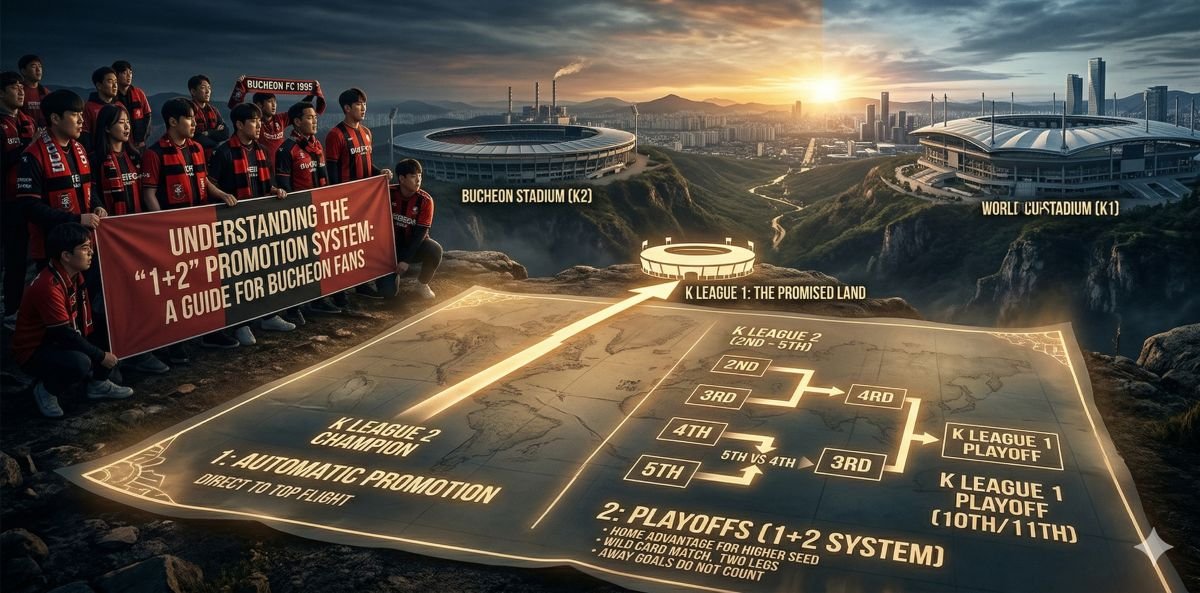
The term “1+2” refers to the number of potential promotion slots available to K League 2 clubs. In this framework, only one team is guaranteed a spot in the top flight (K League 1), while two other spots must be fought for through a series of grueling playoff matches.

This system was implemented to ensure that the K League 1 remains highly competitive while providing K League 2 teams with multiple pathways to ascent. For a club like Bucheon FC 1995, this means that even if the top spot feels out of reach by mid-summer, the season is far from over. As long as the team remains in the top five, the dream of promotion stays alive.

1. The Direct Route: The K League 2 Champions

The first path is the most straightforward. The team that finishes the regular season in 1st place in K League 2 receives automatic promotion. There are no playoffs or secondary hurdles for the champion; they simply swap places with the 12th-placed (last) team in K League 1.

For fans, this makes the race for the league title incredibly intense. The difference between finishing 1st and 2nd is not just a trophy—it is the difference between a guaranteed promotion and entering a volatile playoff “lottery” where one bad afternoon can end a year’s worth of progress.

2. The K League 2 Playoff: The “Ladder” Format

The second path involves the teams that finish between 2nd and 5th place. This is where the K League’s unique “ladder” system comes into play. Instead of a standard semi-final bracket, the K League uses a staggered knockout format that rewards teams for their higher regular-season finish.

  • The Semi-Playoff: The 4th-placed team hosts the 5th-placed team in a single-elimination match.

  • The Playoff: The winner of the 4th vs. 5th match moves on to play the 3rd-placed team.

  • The Final Hurdle: The winner of that match then faces the 2nd-placed team.

The team that survives this internal K League 2 gauntlet does not get promoted immediately. Instead, they earn the right to participate in the final Promotion-Relegation Playoff against a top-tier opponent. This “ladder” design is a fascinating study in how legal structures shape user behavior, as it forces teams to fight for every single point in the regular season to secure a higher rung on the ladder, which requires fewer playoff matches to advance.

3. The Promotion-Relegation Playoffs: The Inter-League Clash

The final stage of the “1+2” system involves two separate home-and-away series that determine the final makeup of K League 1 for the following season:

  • Series A: The 2nd-placed team from K League 2 faces the 11th-placed team from K League 1.

  • Series B: The winner of the K League 2 “ladder” playoffs faces the 10th-placed team from K League 1.

These matches are played over two legs (home and away). This format is designed to mitigate the element of luck, ensuring that the team that eventually earns the K League 1 spot has demonstrated superior skill and tactical depth over 180 minutes of play.

Why the System Matters for the Bucheon Community

For the Bucheon faithful, this system creates a unique psychological environment. In a traditional league, a team sitting in 5th place with ten games to go might be viewed as having “nothing left to play for.” In the K League, however, 5th place is a vital threshold.

The “1+2” system ensures that the “middle class” of the league remains engaged. It prevents the mid-season stagnation that can occur when the gap between the top two teams and the rest of the field becomes too wide. For an entry-level fan, it is important to realize that a draw in September might feel like a minor result, but in the context of the 5th-place cutoff, it could be the difference between an early vacation and a historic promotion run.

To truly grasp the impact of these movements, fans can benefit from understanding what does promotion to K League 1 actually mean, which details the administrative, financial, and cultural shifts that occur when a club jumps between tiers.

Summary of the “1+2” Impact

The K League’s promotion structure is a sophisticated piece of sports engineering. By combining the meritocracy of a long-form season (the Direct Route) with the localized intensity of tournament play (the Playoff Ladder), the league maintains a high level of engagement across its entire fan base.

For those attending matches in Bucheon or following along online, keeping one eye on the 1st-place gap and the other on the 5th-place boundary is the only way to truly understand the pulse of the season. As the league enters its final months, every goal is a calculation, and every point is a step toward the top flight.

Reading the Numbers: A Beginner’s Guide to How Sports Statistics Work in the KBO and K League

The 2026 KBO season is underway across ten ballparks, and Bucheon FC 1995 is competing in K League 1 for the first time in the club’s modern history — which means a new wave of fans is encountering standings tables, batting averages, expected goals, and win percentages for the first time, without a clear framework for what any of it actually means.

Why Statistics Exist in the First Place

Sports statistics are not decoration. They are a language developed over time to answer a simple question: what actually happened, and how well did each team or player perform? The challenge is that raw numbers — a final score, a win-loss record, a goals tally — only answer part of that question. Understanding what the numbers mean requires knowing what they are designed to measure, and what they are not designed to measure.

This guide covers the most common statistics a new fan will encounter following the KBO and K League 1 in 2026, what each number actually represents, and why no single figure tells the complete story of a team’s form.

How KBO Standings Work

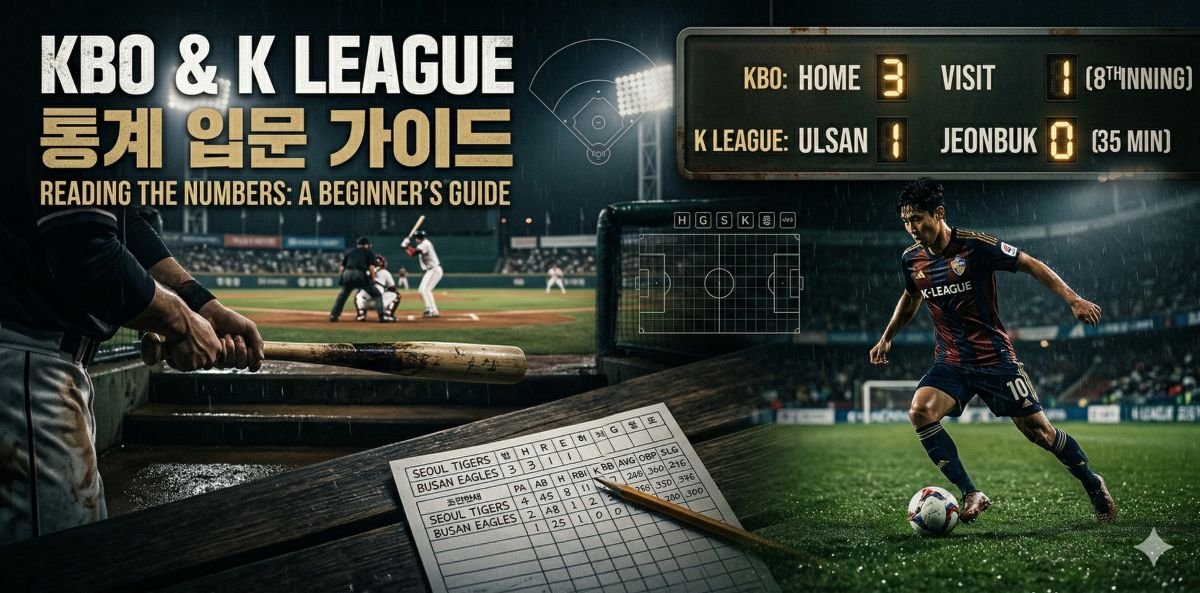
The KBO League uses a straightforward standings structure. Each of the ten clubs plays 144 games across the regular season, facing every other team 16 times. The standings are ranked primarily by winning percentage, which is calculated by dividing the number of wins by the total number of games played, excluding ties. A team with 20 wins and 10 losses has a winning percentage of .667. A team with 15 wins and 15 losses has a winning percentage of .500.

The “games behind” figure — often written as “GB” — tells you how many games separate a team from the leader. If the leading team has a record of 20-10 and your team has a record of 17-13, your team is three games behind. This figure combines wins and losses together, which is why it can change by half a game when only one match is played.

The most important pitching statistic a new fan will encounter is ERA, which stands for Earned Run Average. ERA measures how many runs a pitcher allows per nine innings, adjusted to exclude runs that scored because of fielding errors. A lower ERA indicates a pitcher who is more effective at preventing scoring. In the KBO, an ERA below 3.00 is generally considered strong. An ERA above 5.00 indicates a pitcher who is struggling.

For hitters, batting average is the most commonly cited figure. It is calculated by dividing the number of hits by the number of at-bats. A batting average of .300 — meaning a player gets a hit in 30 out of every 100 at-bats — has historically been considered a mark of a productive hitter in the KBO. However, batting average alone does not capture walks, power hitting, or how often a batter reaches base by means other than a hit. On-base percentage, which counts walks alongside hits, gives a fuller picture of a hitter’s ability to avoid making outs.

How K League 1 Standings Work

The K League 1 standings operate on a points system standard in football leagues worldwide. A win earns three points, a draw earns one point, and a loss earns zero points. After each round of matches, clubs are ranked by total points accumulated. When two teams have identical points, the tiebreaker criteria are applied in sequence: goal difference first, then total goals scored, then head-to-head record.

Goal difference is calculated by subtracting goals conceded from goals scored. A team that has scored 15 goals and conceded 8 has a goal difference of plus seven. Goal difference matters most at the end of a season when clubs are separated by points and the tiebreaker determines which side finishes higher — and in competitive K League 1 seasons, that difference can determine European qualification or relegation survival.

For individual player statistics, goals and assists are the most visible figures. Goals are straightforward — how many times a player has scored. Assists record the final pass or touch that directly created a goal. A player who contributes consistently in both categories is considered an attacking threat even if their goal total alone does not look impressive.

Expected Goals — What the Number Means

New fans following K League 1 coverage in 2026 will increasingly encounter the term “expected goals,” often abbreviated as xG. This is a statistical measure that assigns a probability to each shot based on historical data about similar shots — their location, the type of chance created, and the game situation. A shot from directly in front of goal in open play might carry an xG value of 0.4, meaning similar shots have historically resulted in a goal 40 percent of the time.

Expected goals are useful because they provide a measure of the quality of chances a team created or conceded, independent of whether those chances were converted. A team that loses 1-0 but generated 2.3 xG while conceding only 0.4 xG played well despite the scoreline. A team that wins 2-0 but generated only 0.6 xG while conceding 1.8 xG was fortunate. Understanding the difference between a result and a performance is one of the most practically useful things a new fan can develop.

The distinction between what a scoreline shows and what the underlying data suggests is closely related to a broader interpretive challenge in sports statistics — distinguishing genuine performance signals from short-term fluctuations. The analysis of why momentum shifts in sport are often statistical noise rather than genuine changes in team quality provides useful context for understanding why a team that wins three matches in a row is not necessarily performing better than a team that draws three, and why reading too much into short sequences of results is one of the most common errors new fans make.

Why the Table Does Not Tell the Whole Story

A league table at any given point in a season is a snapshot, not a verdict. Early in a season, small sample sizes mean the standings are highly sensitive to individual results. A team that loses two early matches may sit near the bottom of the table despite playing well. A team that wins two early matches may sit near the top despite generating few quality chances.

For Bucheon FC 1995 fans following the club’s first K League 1 campaign, this interpretive patience matters. Bucheon are a newly promoted club competing against established sides with deeper squads and greater resources. A run of difficult results early in the season does not necessarily indicate that the team is performing below its level — it may simply reflect the fixture schedule, injury timing, or the statistical variance that affects all teams over a small number of games.

Reading sports statistics well means holding two things simultaneously: the number in front of you, and the context required to interpret it honestly. BucheonInsider’s coverage of how local sports communities in Bucheon and Gyeonggi-do engage with sports data and digital content offers a grounded local perspective on how fans in the region are navigating the increased volume of statistics and results coverage that comes with following a K League 1 club for the first time.

The Most Useful Habit for a New Fan

The single most useful habit a new sports fan can develop is to look at multiple statistics together rather than relying on any single figure. In baseball, a pitcher with a high ERA who has faced unusually strong opposition may be performing better than the number suggests. In football, a striker with only three goals who has an xG of 6.5 is likely to score more if the team keeps creating the same quality of chances.

Numbers in sport are tools for understanding, not verdicts. The more context you bring to reading them, the more accurately they reflect what is actually happening on the field.

How Generation Z Watches Sports Differently — and What Digital Literacy Research Says About Learning From Online Platforms

A peer-reviewed study published in February 2026 has found that among Korean Generation Z sports audiences, the ability to access digital sports content and the ability to critically evaluate that content are not the same skill — and the gap between them has measurable consequences for how accurately young fans understand what they are watching.

Access Is Not Competency

South Korea ranks among the most digitally connected societies on earth. Data from the National Information Society Agency indicates that access to digital information among the general population stands at 96.5 percent — a figure that places Korea at the frontier of digital infrastructure development globally. By that measure, the country has effectively solved the access problem. Nearly every citizen can reach digital content.

But the February 2026 study published in Behavioral Sciences, examining how Generation Z engages with sports learning through online platforms, identified a more granular picture beneath that headline figure. While digital access sits at 96.5 percent, digital information utilization — the ability to actually use digital content effectively — stands at 80 percent. Digital competency, defined as the capacity to critically evaluate, contextualize, and apply digital information, sits at 65.6 percent.

That 30-percentage-point gap between access and competency is not a technical problem. It is a behavioral and educational one. It means that a substantial portion of the Korean population, including a significant segment of younger sports audiences, can reach digital sports content without being reliably equipped to evaluate whether that content is accurate, representative, or selectively framed.

How the Study Was Structured

The February 2026 research examined differences in sports learning among Generation Z based on digital literacy levels, using data collected from adults engaged in sports learning through a range of platforms including YouTube, social networking services, online lecture platforms, and mobile applications. Participants were classified into low, medium, and high digital literacy groups, allowing the researchers to measure how literacy level affected the way participants engaged with, retained, and applied sports information encountered through digital channels.

The findings carry direct relevance for understanding how younger Korean sports audiences are actually forming their picture of the sports they follow. Generation Z fans are not primarily accessing sports through scheduled broadcast television. They are accessing it through algorithmically curated social feeds, short-form video clips, creator commentary, fan community posts, and mobile application interfaces — each of which presents sports information through a particular editorial or algorithmic lens that shapes what content reaches the viewer and in what context.

The study’s core insight is that digital literacy determines how well a viewer can account for that lens. A high-literacy user encountering a selectively edited highlight clip, a misleading league table graphic, or a social post misrepresenting a player’s statistical output has the tools to identify the distortion and seek correcting information. A low-literacy user encountering the same content has fewer resources for recognizing that what they are seeing may not accurately represent the underlying reality.

The Probability Problem in Sports Content

This behavioral dynamic connects directly to a well-documented pattern in how sports statistics are processed by audiences with varying levels of analytical familiarity. The intuitive reading of sports data — pattern recognition based on recent results, narrative framing of statistical outliers, selective attention to confirming evidence — is not random noise. It follows predictable paths. The analysis of why intuitive probability reading in sports data produces systematically unreliable conclusions examines the specific cognitive patterns through which sports audiences misread statistical information — patterns that digital literacy training is designed to counteract but that remain active even in high-access environments where accurate information is technically available.

For Generation Z sports audiences consuming content through platforms that optimize for engagement rather than accuracy, these patterns are encountered under conditions that amplify rather than correct them. An algorithm that surfaces content based on engagement metrics will preferentially deliver sports content that generates strong emotional responses — dramatic claims, controversial takes, surprising statistics presented without context — over content that presents accurate but less emotionally charged analysis. The viewer with high digital literacy can recognize and partially compensate for this dynamic. The viewer with lower digital literacy is more likely to take the curated feed as a representative sample of sports reality.

What Digital Literacy Means in a Sports Content Context

The February 2026 study defines digital literacy in terms that extend beyond the ability to operate devices and navigate platforms. Digital literacy, in this framework, encompasses information utilization capabilities grounded in critical thinking and ethical awareness — specifically including the ability to assess the reliability and value of information encountered online.

Translated into sports content terms, this means the capacity to distinguish between a legitimate statistical analysis and a cherry-picked dataset, between a credible injury report and unverified social media speculation, between a meaningful performance trend and a short-term statistical fluctuation that carries no predictive value. These are not abstract analytical skills. They are practical tools for forming an accurate picture of a league table, a player’s actual form, or the significance of a competition result.

The gap between access and competency identified in the National Information Society Agency data suggests that a meaningful portion of Korean sports fans are regularly encountering sports content without the evaluative tools to accurately assess it. This is not a criticism of those fans. It is an observation about the environment in which sports content is now primarily consumed — one that places a premium on analytical skills that formal sports education has rarely prioritized.

The Gyeonggi Dimension

For sports audiences in Anyang and the broader Gyeonggi Province region, where younger fans are among the most active consumers of mobile and social sports content in Korea, the research findings connect directly to local patterns of sports engagement. AnyangInsider’s coverage of sports behavior, digital engagement, and community sports culture in the Gyeonggi region provides context for how these national research findings manifest within local sports communities — where the gap between digital access and digital competency is not a statistical abstraction but a lived dimension of how fans follow the teams and athletes they care about.

Regional sports communities in Gyeonggi-do are also increasingly important sites for youth sports development, meaning that the digital literacy of young sports audiences in this area has implications not just for how they consume sports content but for how they form their understanding of athletic performance, competition integrity, and the institutions that govern the sports they follow.

Why This Research Matters Beyond the Classroom

The February 2026 study is situated in an educational research context, but its implications extend into the broader relationship between sports audiences and the information environments in which they follow sport. As the volume of digital sports content continues to grow, and as the platforms delivering that content become more sophisticated in their optimization for engagement, the analytical skills required to navigate that environment accurately become more rather than less important.

The research finding that high digital literacy produces meaningfully better sports learning outcomes is not only an argument for digital education programs. It is an argument for treating sports information literacy as a genuine competency — one that affects how accurately fans understand the sport they love, how well they can evaluate the claims made about athletes and competitions, and how effectively they can distinguish signal from noise in an environment that generates more of both every year.

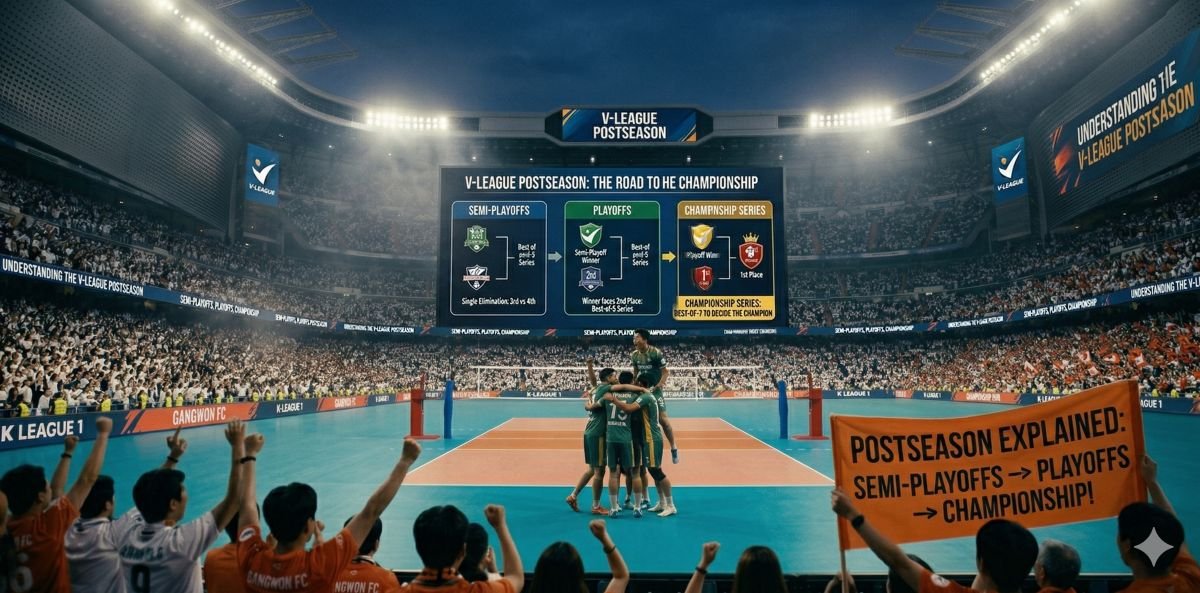
How the V-League Postseason Works: Understanding Semi-Playoffs, Playoffs, and the Championship Series

The 2025-26 V-League season produced results that left many casual viewers with questions. GS Caltex won the women’s championship despite finishing third in the regular season. Korean Air came within one match of completing a treble in the men’s competition. For viewers who tuned in only for the final rounds, the path that brought these teams to the championship stage was not immediately obvious.

The V-League postseason follows a structured format designed by the Korea Volleyball Organization. Understanding how that format works explains outcomes that might otherwise seem surprising.

How Teams Qualify for the Postseason

At the end of the regular season, the top three teams in each division automatically advance to the postseason. The fourth-placed team has a conditional path: if it finishes within three points of the third-placed team, a single semi-playoff match is held between the two clubs to determine who claims the third postseason spot.

This three-point threshold is the first decision point in the postseason structure. When the gap is wider than three points, no semi-playoff is held and the third-place team advances directly. When the gap is narrow enough, the fourth-placed team earns one opportunity to displace the team above it.

Ties in the regular season standings are not broken arbitrarily. The Korea Volleyball Organization resolves them first by set ratio, then by point ratio, and finally by head-to-head match results. This sequence ensures that the final standings reflect performance across the full season rather than a single deciding factor.

What the Semi-Playoff Is

The semi-playoff, when triggered, is a single match. There is no second chance. The winner takes the third seed in the postseason bracket and the loser’s season ends. This format places significant weight on one game and creates a sharp contrast with the multi-match series that follow later in the bracket.

Because the semi-playoff produces immediate elimination, it functions differently from the rest of the postseason structure. Teams entering it as the fourth seed carry the pressure of an all-or-nothing format, while the third-seeded team risks losing a secured postseason position in a single outing. This kind of single-elimination pressure also shapes how momentum shifts are read in real time — a concept explored further at economicseoul.com in its breakdown of 모멘텀 전환과 통계적 변동성, which examines how live match data reflects genuine turning points versus statistical noise.

How the Playoff and Championship Series Work

Once the three postseason teams are confirmed, the bracket takes shape in the following way.

The first-placed team from the regular season receives a bye. That club advances directly to the championship series without playing in the semifinal round. This structural advantage rewards regular season performance by giving the top seed additional rest and preparation time.

The second- and third-placed teams meet in a best-of-five semifinal series. The first team to win three matches in that series advances to face the first-placed team in the championship. The losing team is eliminated.

The championship series is also contested as a best-of-five. The first team to win three matches in the championship is crowned V-League champion.

The GS Caltex Path as a Structural Example

The 2025-26 women’s competition illustrates how this format operates in practice.

GS Caltex finished the regular season in third place. Under the postseason structure, that position placed the club in the semi-playoff, where it defeated Heungkuk Life Insurance in the single-elimination match to secure the third seed in the bracket.

GS Caltex then faced Hyundai E&C in the best-of-five semifinal and advanced by winning the series 2-0, reaching the championship finals for the first time since the 2020-2021 season.

From there, GS Caltex competed in the championship series and won, claiming the title despite never having finished higher than third in the regular season standings. The postseason format made this possible because it is structured to give lower seeds a genuine competitive path rather than treating regular season rank as a predetermined outcome.

Why Regular Season Position Does Not Determine the Champion

A common misconception among viewers new to the V-League is that the team finishing first in the regular season is the likely or expected champion. While first place carries a real structural advantage — the direct entry into the championship series without playing a semifinal — it does not guarantee a title.

The bracket requires the first-placed team to win three matches in the championship series regardless of how dominant its regular season was. A third-seeded team that wins three semifinal matches and then wins three championship matches earns the same title.

This is the essential point the GS Caltex result demonstrates. Third place in the regular season is not a consolation position. It is a starting point within a bracket that rewards postseason performance. Readers who want a comparable structural breakdown in a different sport can find a useful parallel in this guide on how Korean football’s tier system works — another format where finishing position determines a starting point rather than a final outcome.

For readers following the V-League across future seasons, this structural understanding reframes what regular season standings mean. They determine seeding and bracket position. The championship is decided separately.

Understanding the K League Split System and the 2026 Finale

The 2026 K League 1 season represents a significant milestone for football fans in South Korea. It is a year of transition, marking the final time the league will use its signature split system before a major expansion in 2027. For anyone new to the league, the current structure can feel a bit like a puzzle. Unlike many European leagues where teams play each other a set number of times and the table stays as one unit, the K League adds a twist in the final stretch of the season. Understanding this format is key to following the drama of the current year, especially as the league prepares for a new era.

The Mechanics of the Split

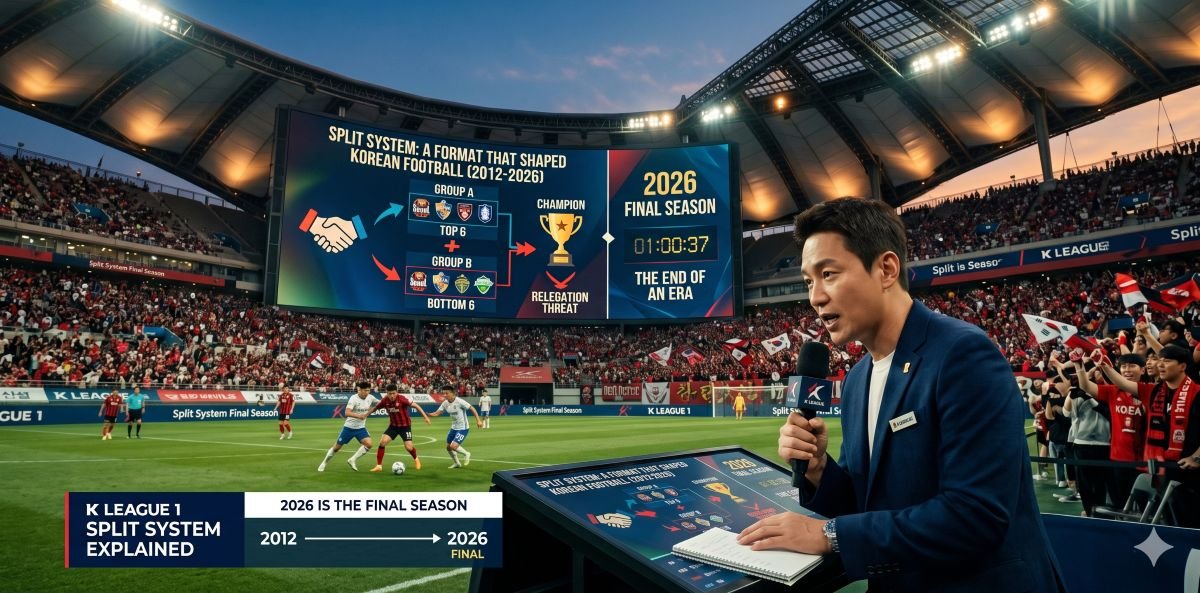
At its core, the split system is a way to divide the twelve teams of K League 1 into two distinct groups during the latter part of the season. The league begins with a regular season where every team plays each other three times, totaling thirty-three matches. Once these games are completed, a line is drawn through the middle of the standings. This is often called the Line of Death by fans because it determines a club’s fate for the rest of the year.

The teams ranked from first to sixth move into a group called Final A. These clubs compete for the league title and qualification for continental tournaments like the AFC Champions League. The teams ranked from seventh to twelfth move into Final B. Their primary goal shifts to survival, as they fight to avoid relegation to the K League 2.

A crucial point for new observers is that points earned during the first thirty-three matches carry over into the final stage. However, once the split happens, a team in Final B cannot move up into Final A, even if they end the season with more total points than a team in the top half. This creates two separate mini-leagues for the final five matches of the year.

Read also: How to Read a K League Season: A First-Timer’s Guide to Formats, Splits, and Matchday Structure

A History of Change

The split system was not always part of Korean football. It was introduced in 2012 when the division had sixteen teams. At that time, the league was looking for ways to increase the intensity of matches and ensure that every game had something at stake. In the years that followed, the number of teams in the top flight fluctuated, moving to fourteen teams in 2013 and eventually settling on the twelve-team format that fans know today.

Over the last decade, the system has provided high levels of drama. Because Final B teams only play against other teams facing relegation, those matches often feel like cup finals. Similarly, every game in Final A is a high stakes encounter between the top clubs in the country. While the system can be confusing at first, it was designed to prevent teams in the middle of the table from having nothing to play for in the final weeks.

Bucheon FC 1995 and the 2026 Milestone

The 2026 season is particularly special for Bucheon FC 1995. This year marks the first time the club has ever competed in K League 1. Known to their fans as the Reds, Bucheon joined the top tier after a successful promotion campaign, following in the footsteps of clubs like Suwon FC and FC Anyang.

For Bucheon and their supporters, 2026 is a unique opportunity to experience the split system before it disappears. As the new kids in the league, their primary focus will likely be securing a spot in the top half or fighting for every point in Final B. Their presence adds a fresh narrative to the final year of this format, giving a local community a chance to engage with the structural quirks that have defined the league for over a decade.

Why the System is Ending

The decision to move away from the split system is tied to the expansion of K League 1. Starting in the 2027 season, the top division will grow from twelve clubs to fourteen. This expansion is a result of the growing health and popularity of professional football in South Korea.

To reach that fourteen-team goal, the 2026 promotion and relegation rules are quite specific. The top two teams from K League 2 will earn automatic promotion to the 2027 top tier. Additionally, the winner of a final promotion playoff will also move up. This path to expansion makes the split system logistically difficult to maintain. With fourteen teams, a split would create odd numbers or require a schedule that is too long for the calendar.

What Happens in 2027

When the 2027 season kicks off, fans will see a more traditional league structure. The fourteen teams will compete in three round robins. This means every team will play each other three times, and the final standings will be determined by the single, unified table after all matches are finished.

This move toward a larger, more conventional league reflects a desire for stability and simplicity. It allows for a straightforward narrative where every team’s position is always relative to everyone else in the league. While the split system brought a unique energy to the end of the season, a fourteen-team league provides a broader representation of cities and regions across Korea.

The Final Drama of 2026

For the fans currently filling stadiums in 2026, the focus remains on the present. The upcoming split in the latter half of the year will be the final time that the Line of Death is drawn. It is a chance to celebrate the intensity that this format has provided since 2012.

As teams like the LG Twins and Kia Tigers continue their traditional rivalries, and newcomers like Bucheon FC 1995 find their footing, the structural change looms in the background. The end of the split system is a sign of progress, marking the moment when the K League outgrows its current clothes and moves into a larger stadium. For now, supporters can enjoy the specific tension of Final A and Final B one last time, knowing that they are witnessing a closing chapter in the history of the sport.

How the KBO League Season Works — A Beginner’s Guide to Korean Baseball in 2026

The 2026 KBO League season is underway, and for first-time followers in Bucheon, Suwon, and across Gyeonggi-do, the sheer number of games, the unfamiliar playoff format, and the new rules introduced this year can make the sport feel more complicated than it needs to be. This guide breaks it all down from the beginning.

What the KBO League Is

The Korea Baseball Organization League — universally known as the KBO — is South Korea’s top professional baseball competition. Founded in 1982 with six teams, the league has grown to its current format of ten clubs competing across a full season that runs from late March through October. The 2026 season is the 45th edition of the competition, and it is the most widely followed domestic sport in the country by attendance.

The ten clubs are spread across South Korea’s major cities. Fans in the Gyeonggi-do region often follow teams based in nearby Seoul and Incheon, including the LG Twins, Doosan Bears, and SSG Landers, though every club has a national following that tracks games online and through broadcast.

The Regular Season: Nearly Daily Baseball for Six Months

The KBO regular season is long and dense by design. The 2026 season began on March 28 and runs through September 6. During that window, each of the ten teams plays 144 games — facing every other team in the league 16 times across the schedule. Games are played every day of the week except Mondays, which function as the league’s universal rest day.

For a new fan, this schedule density is often the first surprise. Korean professional baseball is not a weekend event. It is a near-daily fixture in the sports calendar for six months straight. A team might play a three-game series in Daejeon, travel to Busan for three more, and return home for a weekend set — all within a single week.

This structure means the standings shift constantly. A team that looks dominant in April might cool significantly by July, and a club that starts poorly can rebuild its position across the long haul of the season. The volume of games is what makes the KBO standings a genuinely meaningful indicator of quality — random results average out over 144 games in a way they simply cannot over 30 or 40.

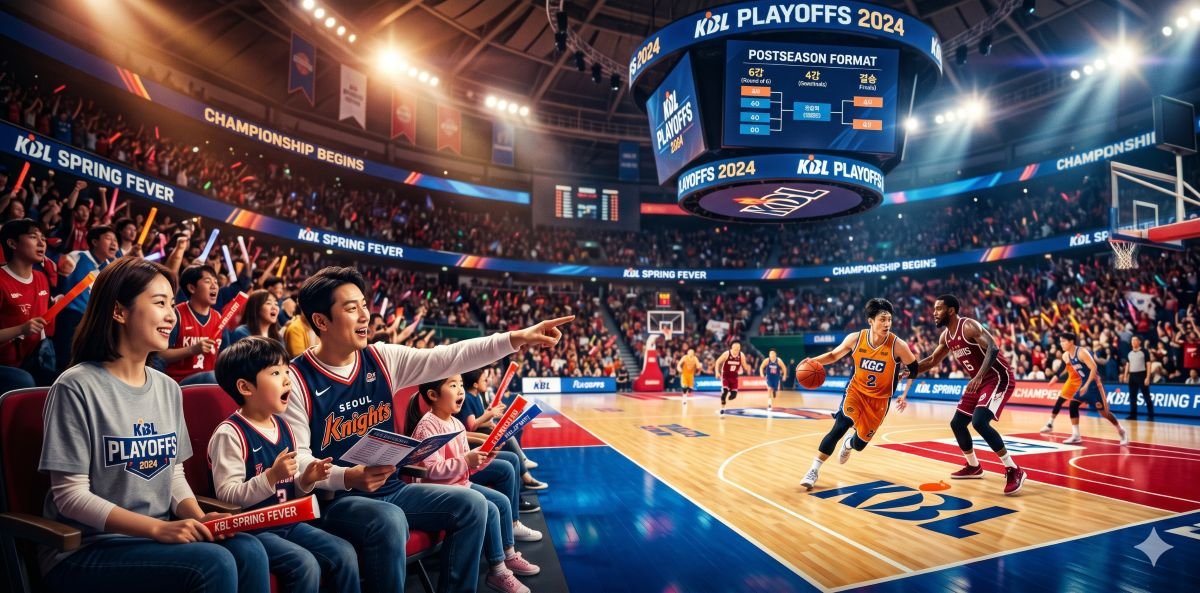
How the Postseason Works: A Step-Ladder System

At the end of the regular season, the top five teams by win-loss record advance to the postseason. This is where the format becomes distinctive.

The KBO postseason uses a step-ladder structure, meaning teams enter the competition at different points depending on where they finished in the regular season. The team that finishes fifth plays the fourth-place team in a Wild Card Game, where the fourth-place side begins with a built-in advantage — they need only one win to advance, while the fifth-place team must win twice.

The winner of the Wild Card Game then plays the third-place team in a best-of-three Semi-Playoff series. The winner of that series advances to face the second-place team in a best-of-five Playoff series. Finally, the winner of the Playoff series meets the regular season champions — the team that finished first — in the Korean Series, a best-of-seven championship that determines the year’s title.

This structure rewards regular season performance directly. Finishing first means sitting out the early rounds entirely and entering fresh against a team that has already played multiple elimination games. Finishing fifth means surviving the most dangerous gauntlet, needing to beat three separate opponents just to reach the championship round.

What Changed for 2026: The Pitch Clock and the Asian Quota

Two rule changes introduced for 2026 are worth understanding because they directly affect how games feel and how rosters are built.

The first is the pitch clock adjustment. In 2025, the KBO introduced a pitch clock for the first time — a timer that limits how long pitchers can take between deliveries. That change immediately shortened average game times to three hours and two minutes, the fastest average since the year 2000. For 2026, the KBO tightened the clock further. Pitchers must now begin their delivery within 18 seconds when the bases are empty, reduced from 20 seconds, and within 23 seconds with runners on base, down from 25. The intent is to keep the pace of play moving and prevent the extended dead time between pitches that used to stretch games well past three hours.

The second change involves roster composition. Previously, each KBO team could sign up to three foreign players. In 2026, that limit increased to four — but the additional slot is specifically reserved for players from Asian countries, under what the league calls the Asian Quota System. This change opens the door for players from Japan, Taiwan, and other Asian baseball markets to join KBO rosters more easily, expanding the international character of the league.

How to Follow the Season as a New Fan

The simplest entry point for a new KBO fan is the standings. Checking where a team sits in the ten-team table after each week gives an immediate sense of the season’s shape. As the September 6 end date approaches, the race for the final postseason spots tends to produce some of the most competitive and closely watched games of the entire year.

For context on how Korean sports leagues structure their seasons and what the tier system means for competition format, How to Read a K League Season offers a useful parallel guide focused on football that applies many of the same structural concepts.

Understanding variance and why a single result rarely tells the full story of a team’s quality is one of the deeper lessons that long-format leagues like the KBO teach naturally over time. The foundational logic behind that concept is explored in 왜 강팀도 자주 패배하는가 — a useful analytical companion to following any high-volume sports competition.

The KBO season is long for a reason. The format is designed to reward consistency, expose weakness, and produce a champion that has genuinely earned the title across 144 games and a demanding postseason gauntlet. For a first-time follower, the best approach is simply to pick a team and start watching. The structure will make more sense with every week that passes.

What It Means When a Club Gets Promoted: Understanding Bucheon FC 1995’s Historic Arrival in K League 1

Bucheon FC 1995 has made history by reaching K League 1 for the first time in the club’s existence. For fans unfamiliar with how Korean professional football is structured, this moment offers the most locally grounded, concrete way to understand what promotion actually means — and why it carries weight far beyond a number on a standings table.

A Club Born from Loss

The story of Bucheon FC 1995 does not begin with a trophy or a transfer. It begins with a city losing its team.

In early 2006, Bucheon SK relocated to Jeju Island, leaving behind a fanbase with no club to call their own. Within weeks, a group of former Bucheon SK supporters decided they would not simply move on. They began organizing, fundraising, and building something new from nothing. By December 2007, Bucheon FC 1995 was officially founded — a community-owned club whose name carries the year 1995, the year the predecessor club first arrived in Bucheon.

That founding story matters when thinking about promotion. This is not a franchise relocated by a corporation or a club backed by a conglomerate. Bucheon FC 1995 was built by the people who felt the absence of football most keenly. When a club like that reaches the top tier of Korean professional football, it is not just a sporting result. It is the completion of something that started the moment a city decided to rebuild.

What the Promotion and Relegation System Actually Is

For a reader encountering Korean professional football for the first time, the structure can seem complicated. It does not have to be.

Korean professional football operates across two primary divisions. K League 1 is the top tier, featuring the country’s most competitive clubs including Jeonbuk Hyundai, FC Seoul, and Ulsan HD. K League 2 sits directly below it — a fully professional second division where clubs compete each season for the chance to rise.

At the end of every K League 2 season, the top two finishers earn automatic promotion to K League 1 the following year. Below those automatic spots, additional promotion places are decided through a multi-team playoff series. The winners of those playoffs claim the final available spot in the top division. Meanwhile, clubs finishing at the bottom of K League 1 face the opposite journey — either automatic relegation to K League 2 or a high-stakes playoff to preserve their status.

This system means that every match in every round carries direct consequences. A result in March can influence whether a club is playing in front of ten thousand fans the following season or forty thousand. The league table is not just information — it is a live mechanism that determines which division a club occupies next year.

Bucheon FC 1995 joined K League 2 in 2013 and spent more than a decade competing in the second tier. For years, the club never even reached the promotion playoffs. That changed in 2025, when Bucheon navigated the playoff series and defeated Suwon FC across two legs, winning 4-2 on aggregate to claim their place in K League 1 for the first time in the club’s history.

What Actually Changes When a Club Gets Promoted

Promotion is not simply a change of label. It reshapes almost every dimension of how a football club operates.

The competition level rises sharply. In K League 2, Bucheon were regularly among the stronger sides. In K League 1, they enter a division where every opponent has been competing at the highest domestic level. The margins for error are smaller, the opponents more experienced, and the tactical demands more complex across a full season.

The fixture schedule becomes more demanding. K League 1 clubs play against a broader range of opponents with less margin to rotate or recover. Squad depth, fitness management, and coaching quality are all tested more severely across the course of a campaign.

The club’s operational scale expands. Higher division football brings larger crowds, greater media exposure, and more revenue potential. For a citizen-owned club like Bucheon, that increase in visibility also comes with greater scrutiny and higher expectations from a growing supporter base.

For fans, the experience changes entirely. Away trips now mean visits to some of the most recognizable stadiums in Korean football. Home matches draw more attention from national media. The club becomes part of conversations that previously happened without them.

The First Match and What It Signaled

Bucheon FC 1995’s opening K League 1 fixture delivered something that exceeded even the most optimistic expectations. Facing defending champions Jeonbuk Hyundai away at Jeonju World Cup Stadium, Bucheon fell behind early but refused to collapse. They came from behind to win 3-2, with Jefferson Galego scoring what became the first K League 1 goal in the club’s history.

A comeback victory on the road against the reigning champions, in the very first match at the highest level — that result told the Korean football world that Bucheon had not arrived simply to participate.

Why This Story Matters Beyond Football

Promotion means different things depending on who is watching. For a neutral observer, it is a structural outcome produced by a playoff result. For a Bucheon fan who has followed this club since it was founded in a room full of people who refused to give up on their city’s football, it is the proof that the entire journey was worth it.

Understanding the promotion and relegation system is the entry point. But the deeper lesson that Bucheon FC 1995 offers is that the system exists to reward exactly this kind of persistence — clubs that build from the ground up, compete honestly, and earn their place through performance rather than investment alone.

For a fuller breakdown of how K League’s tier structure works from the bottom up, the guide at What Does Promotion to K League 1 Actually Mean walks through the full format in plain language. For analytical context on why handicap market structures exist in tiered competition systems, 핸디캡 마켓이 존재하는 이유 provides useful structural framing.

Bucheon FC 1995’s story in K League 1 is only beginning. The promotion was the destination for seventeen years of effort. What comes next is the competition itself.

How to Read a K League Season: A First-Timer’s Guide to Formats, Splits, and Matchday Structure

The 2026 K League 1 season marks the final chapter of a format that has defined Korean top-flight football since 2012 — a 12-team split system with a Final A and Final B structure that will be replaced from 2027 by an expanded 14-team league. For new supporters following Bucheon FC 1995’s debut in the top flight, understanding what a “split” means, how points carry over, and what the season’s phases actually look like can be genuinely confusing. Here is a plain-language breakdown of how a K League 1 season works from first matchday to final whistle.

The Basic Shape of a Season

A K League 1 season does not run like most European leagues, where teams simply play home-and-away fixtures until a final table is produced. The Korean top flight uses a two-phase format: a regular season followed by a split phase.

The K League 1 season is played over 38 rounds — 33 as part of the regular season and five in the K League “Final.” The 12 teams play each other three times pre-split and then one more time post-split.

That asymmetry — three encounters between clubs in the regular season rather than two — is what makes the K League format feel unfamiliar to supporters used to other leagues. When 12 teams each play one another three times, the total comes to 33 rounds. After those 33 matchdays are complete, the split begins.

What the Split Actually Means

The split is the mechanism that divides the league into two separate groups for the final five rounds of the season. Each club plays each other three times in the regular round, then the top and bottom six teams are split into Split A and Split B, in which a team plays every other team in the split once, to decide the final standings.

In everyday K League language, Split A is called Final A and Split B is called Final B.

The top six teams contest Final A, playing each other once. The bottom six teams contest Final B, also playing each other once. The key point here is that points accumulated from the regular season are carried over into the split phase. No points are reset. A team that enters the split with 55 points continues from 55 points. The five additional matches simply add to what has already been earned.

This means the split does not create a clean second competition — it is a continuation of the same table, with clubs now confined to playing only opponents from their own group.

What Is at Stake in Each Group

The two groups serve entirely different competitive purposes, and that is by design.

Final A teams are playing for three spots in the AFC Champions League. Final B teams are playing to avoid the bottom two spots, with the last-placed team facing automatic relegation to K League 2, and the 11th-placed team contesting the promotion-relegation playoff with a K League 2 opponent.

The K League 1 title winners qualify for the AFC Champions League Elite, as do the Korea Cup winners if they also finish in the top four. The K League 1 runners-up also earn an AFC Champions League Elite place, while third place qualifies for AFC Champions League Two.

There is one other structural detail worth noting for Bucheon supporters specifically: a team that qualifies for Final A is guaranteed to finish no lower than sixth place in the league. Even if a Final B team ends up with a higher point total than a Final A team at the end of the season, they will finish no higher than seventh place. Finishing position, in other words, is locked once the split is determined.

Points and Tiebreakers

Points are awarded with three for a victory, one for a draw, and zero for a defeat, accumulating to rank teams throughout the season.

When clubs are level on points, the K League uses a specific tiebreaker sequence. The rules for classification are: first, points; second, goals scored; third, goal difference; fourth, wins; fifth, head-to-head points. This differs from most European leagues, which prioritise goal difference over goals scored — a detail that can affect how clubs approach matches late in the season.

For a more detailed look at how sports league structures and their statistical frameworks affect competitive outcomes, daejeoninsider.com has a useful overview of sports analysis methodology and how structural factors are evaluated.

The Matchday Experience

The K League 1 season typically begins in late February and the league goes on a World Cup break from the end of May to early July. Matchdays are generally held across weekends, with some midweek fixtures scheduled around AFC Champions League commitments and cup competitions.

The Korea Cup runs alongside the league season. From 2026, the Korea Cup is switching to an autumn-spring format, with the early rounds taking place in July and August 2026, and the quarterfinals through the final held in May and June 2027. For supporters attending matches, this means a busy calendar with cup fixtures interspersed between league rounds.

Matchday squads in K League 1 consist of 20 players. Clubs will now have five substitutions in 2026, and the U22 mandatory appearance rule has been lifted, though at least two U22 players must still be named in the matchday squad.

Why 2026 Is the Last Season of This Format

The 2026 season will be the last of a 12-team K League 1 and will see the end of the split, Final A and Final B system. From 2027, K League 1 will have 14 teams with three round robins.

The split system came into effect in 2012 in what was a 16-team K League 1, then a 14-team division in 2013, before becoming the 12-team league it is today the following year. For more than a decade, Final A and Final B have structured the Korean football season’s defining weeks. From 2027, that framework gives way to a simpler three-round-robin structure across a larger field of clubs.

For Bucheon FC supporters experiencing top-flight football for the first time, understanding how that timeline and league structure connects to their club’s journey is worth exploring further. Bucheon Insider has context on how league governance shapes market availability and the competitive conditions clubs face.

Bucheon’s debut K League 1 season arrives in what is simultaneously the format’s final year and the most structurally forgiving environment for a newly promoted side. Knowing how the season is built — round by round, split by split — is the first step to following it properly.