

What Does Promotion to K League 1 Actually Mean? A Beginner’s Guide to How Korean Football’s Tier System Works

Bucheon FC 1995 earned promotion to K League 1 for the first time in the club’s history after defeating Suwon FC in the promotion-relegation playoff — and for many new fans in Bucheon, that moment raised a straightforward but important question: what exactly just happened, and why does it matter so much?
Bucheon FC defeated Suwon FC 3-2 in the second leg of their K League promotion-relegation playoff, capturing the series 4-2 on aggregate. The scenes that followed were extraordinary. But to understand why this result sent shockwaves through Korean football — and why Bucheon’s fanbase had been waiting nearly two decades for this moment — it helps to first understand how the K League system is actually structured.
How the K League Tier System Works
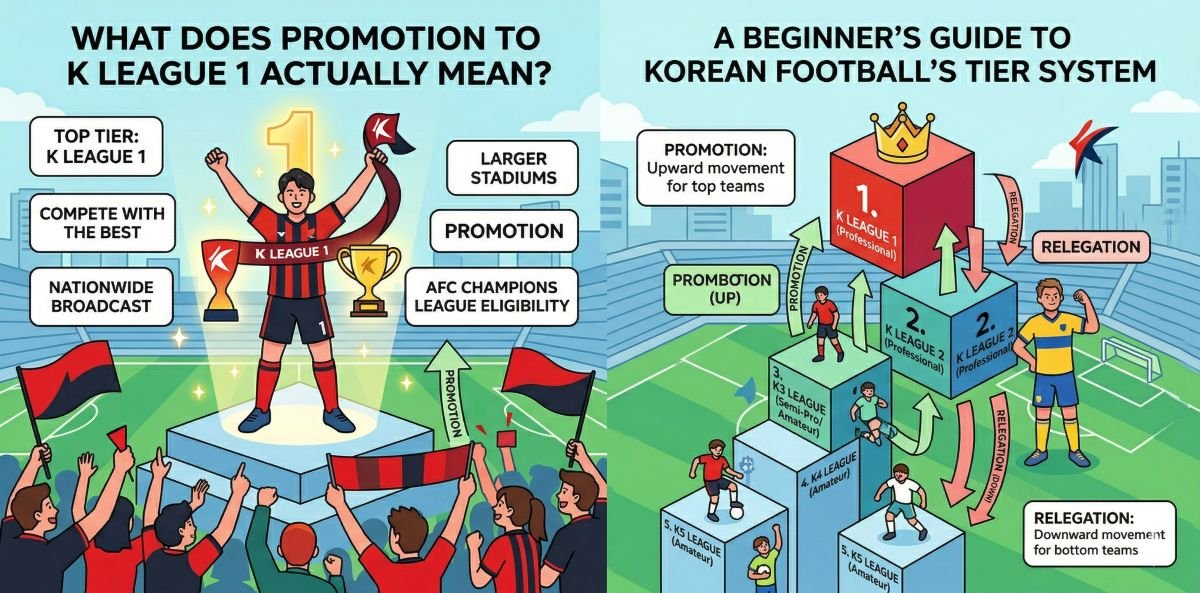
Korean professional football operates across two main divisions. Below K League 1 is the second-tier K League 2, and both form the K League as professional championships. Under them sit two semi-professional leagues — the K3 and K4 Leagues — and three amateur leagues below those.
K League 1 is the country’s top flight. Competing there means facing the strongest clubs in South Korea — larger squads, bigger budgets, and stadiums with greater matchday atmosphere. On 22 January 2018, the top-flight competition was officially renamed K League 1. It has been the proving ground for Korean football since the league’s founding in 1983.
K League 2, by contrast, is where clubs develop, rebuild, or spend years without breaking through. After joining the second-tier K League 2 in 2013, Bucheon had never even competed in promotion-relegation playoffs until the 2025 season. That is more than a decade of professional football without once reaching the moment that defines a club’s ambitions.
What Promotion and Relegation Actually Mean
Promotion and relegation are the mechanisms that allow clubs to move between tiers based on performance. A club that finishes at the top of K League 2 earns the right to compete in K League 1 the following season. A club that finishes at the bottom of K League 1 drops down to K League 2.
The K League promotion-relegation playoffs were introduced in 2013 and are contested between clubs finishing in the lower positions of K League 1 and the higher positions of K League 2. The first leg is always played at the second division team’s home ground, while the second leg is played at the first division team’s home ground.
This format produces some of the most dramatic moments in Korean football. The two-legged structure means a club must perform across two matches — often in hostile environments — to either secure a place in the top flight or defend an existing one. If teams are tied on aggregate after 90 minutes in the return fixture, extra time applies, though away goals do not count.
For a broader look at how settlement rules and match outcomes are handled across different sporting contexts, bucheoninsider.com has a useful breakdown on why settlement rules differ by sport.
The Road Bucheon FC Took to Get Here
Understanding what Bucheon achieved requires understanding the specific route they navigated in 2025. They did not earn automatic promotion by winning the K League 2 title outright. Instead, Bucheon finished third in the regular season — their highest-ever finish — before defeating K League 1 side Suwon FC in the promotion-relegation playoffs.
The route through the playoffs for a third-place K League 2 side is not straightforward. They must first navigate internal K League 2 playoff rounds before reaching the cross-division series against a K League 1 opponent. What set Bucheon apart was their steely determination to get the job done. They were ready for Suwon FC — confident, in-form, and in possession of a squad that had grown consistently throughout the campaign.
Bucheon finished the regular season with 19 wins and 67 points, with midfielder Takahashi Kazuki pointing to strong scouting and a fast start as the foundation of their successful campaign.
What Changes When a Club Moves Up
Promotion to K League 1 is not simply a change of division. It reshapes almost everything about how a club operates.
Competition level rises sharply. K League 1 clubs compete against South Korea’s most established football institutions — clubs like Jeonbuk Hyundai Motors, Ulsan HD, and Jeju SK — all with larger rosters, better facilities, and deeper financial resources. The calibre of player increases dramatically from February onward, and Bucheon will need to address defensive stability over the winter to prepare for that step up.
Survival becomes the primary objective. For newly promoted sides, avoiding immediate relegation is the benchmark for a successful first season. Another small-budget, city-owned club, FC Anyang, relied on smart recruitment and an experienced squad to secure top-flight survival in 2025 — and Bucheon’s priority is similar: turn Bucheon Stadium into a fortress.
The structure of the season changes. K League 1 clubs play more competitive matches across the calendar, and the schedule demands greater squad depth throughout. Rotation and roster management become far more consequential decisions than they were in the second tier.
Fan experience transforms. Home matches carry elevated significance. Rivalries become more charged. For Bucheon specifically, meetings with Jeju SK promise particular intensity given the history between the clubs — Jeju is the former Bucheon SK that relocated to the island in 2006, a move Bucheon fans understandably still resent.
Why the 2026 Season Is an Unusual Time to Go Up
Bucheon’s promotion arrives at a moment of structural change within Korean football. K League 1 will expand from 12 to 14 teams at the end of the 2026 season, meaning Bucheon cannot be automatically relegated. Only Gimcheon Sangmu are guaranteed to go down regardless of their finish. This gives a newly promoted side more room to find their footing without the immediate threat of a single bad run sending them straight back down.
The expansion to 14 teams in 2027 means more clubs will win promotion from K League 2 in order to fill the extra spaces, signaling a broader opening of Korean football’s pyramid that will reshape the competitive landscape for years ahead. For context on how league governance decisions shape the conditions clubs compete under, seoulmonthly.com has a detailed analysis of sports analysis methodology and how structural factors are evaluated.
What This Means for Bucheon as a City
The significance of Bucheon FC 1995’s promotion extends beyond football results. The club was founded by supporters after the original Bucheon SK relocated to Jeju Island in 2006, effectively stripping the city of its professional football identity. Bucheon FC 1995 was officially founded on 1 December 2007 by a group of former Bucheon SK supporters, initially targeting entry into amateur football before eventually becoming a fully professional club.
That origin story — a fan-led club working its way from the amateur tiers to the top flight — makes the 2025 promotion one of the more meaningful achievements in recent K League history. After years of battling through the second-tier, finishing bottom as recently as 2021, the emotions ran deep when promotion was finally confirmed.
For new fans now following the club into its K League 1 chapter, the tier system is no longer an abstract concept. It is the very structure that explains why a football city waited nearly two decades to see its team compete at the highest level — and why that wait finally came to an end.