

How to Read a K League Season: A First-Timer’s Guide to Formats, Splits, and Matchday Structure

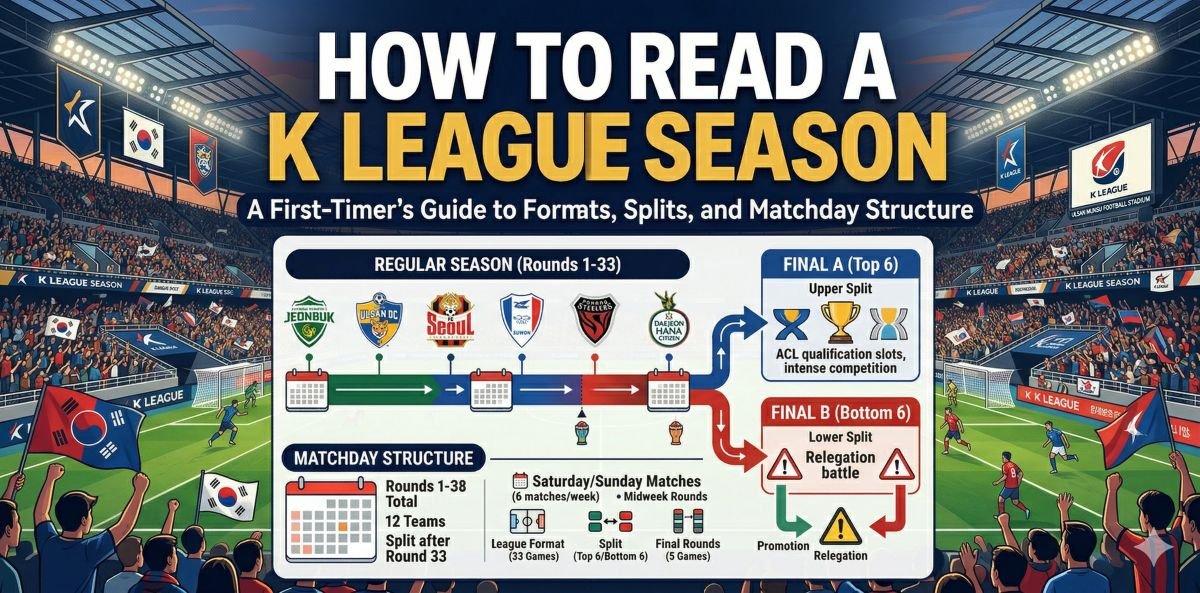
The 2026 K League 1 season marks the final chapter of a format that has defined Korean top-flight football since 2012 — a 12-team split system with a Final A and Final B structure that will be replaced from 2027 by an expanded 14-team league. For new supporters following Bucheon FC 1995’s debut in the top flight, understanding what a “split” means, how points carry over, and what the season’s phases actually look like can be genuinely confusing. Here is a plain-language breakdown of how a K League 1 season works from first matchday to final whistle.
The Basic Shape of a Season
A K League 1 season does not run like most European leagues, where teams simply play home-and-away fixtures until a final table is produced. The Korean top flight uses a two-phase format: a regular season followed by a split phase.
The K League 1 season is played over 38 rounds — 33 as part of the regular season and five in the K League “Final.” The 12 teams play each other three times pre-split and then one more time post-split.
That asymmetry — three encounters between clubs in the regular season rather than two — is what makes the K League format feel unfamiliar to supporters used to other leagues. When 12 teams each play one another three times, the total comes to 33 rounds. After those 33 matchdays are complete, the split begins.
What the Split Actually Means
The split is the mechanism that divides the league into two separate groups for the final five rounds of the season. Each club plays each other three times in the regular round, then the top and bottom six teams are split into Split A and Split B, in which a team plays every other team in the split once, to decide the final standings.
In everyday K League language, Split A is called Final A and Split B is called Final B.
The top six teams contest Final A, playing each other once. The bottom six teams contest Final B, also playing each other once. The key point here is that points accumulated from the regular season are carried over into the split phase. No points are reset. A team that enters the split with 55 points continues from 55 points. The five additional matches simply add to what has already been earned.
This means the split does not create a clean second competition — it is a continuation of the same table, with clubs now confined to playing only opponents from their own group.
What Is at Stake in Each Group
The two groups serve entirely different competitive purposes, and that is by design.
Final A teams are playing for three spots in the AFC Champions League. Final B teams are playing to avoid the bottom two spots, with the last-placed team facing automatic relegation to K League 2, and the 11th-placed team contesting the promotion-relegation playoff with a K League 2 opponent.
The K League 1 title winners qualify for the AFC Champions League Elite, as do the Korea Cup winners if they also finish in the top four. The K League 1 runners-up also earn an AFC Champions League Elite place, while third place qualifies for AFC Champions League Two.
There is one other structural detail worth noting for Bucheon supporters specifically: a team that qualifies for Final A is guaranteed to finish no lower than sixth place in the league. Even if a Final B team ends up with a higher point total than a Final A team at the end of the season, they will finish no higher than seventh place. Finishing position, in other words, is locked once the split is determined.
Points and Tiebreakers
Points are awarded with three for a victory, one for a draw, and zero for a defeat, accumulating to rank teams throughout the season.
When clubs are level on points, the K League uses a specific tiebreaker sequence. The rules for classification are: first, points; second, goals scored; third, goal difference; fourth, wins; fifth, head-to-head points. This differs from most European leagues, which prioritise goal difference over goals scored — a detail that can affect how clubs approach matches late in the season.
For a more detailed look at how sports league structures and their statistical frameworks affect competitive outcomes, daejeoninsider.com has a useful overview of sports analysis methodology and how structural factors are evaluated.
The Matchday Experience
The K League 1 season typically begins in late February and the league goes on a World Cup break from the end of May to early July. Matchdays are generally held across weekends, with some midweek fixtures scheduled around AFC Champions League commitments and cup competitions.
The Korea Cup runs alongside the league season. From 2026, the Korea Cup is switching to an autumn-spring format, with the early rounds taking place in July and August 2026, and the quarterfinals through the final held in May and June 2027. For supporters attending matches, this means a busy calendar with cup fixtures interspersed between league rounds.
Matchday squads in K League 1 consist of 20 players. Clubs will now have five substitutions in 2026, and the U22 mandatory appearance rule has been lifted, though at least two U22 players must still be named in the matchday squad.
Why 2026 Is the Last Season of This Format
The 2026 season will be the last of a 12-team K League 1 and will see the end of the split, Final A and Final B system. From 2027, K League 1 will have 14 teams with three round robins.
The split system came into effect in 2012 in what was a 16-team K League 1, then a 14-team division in 2013, before becoming the 12-team league it is today the following year. For more than a decade, Final A and Final B have structured the Korean football season’s defining weeks. From 2027, that framework gives way to a simpler three-round-robin structure across a larger field of clubs.
For Bucheon FC supporters experiencing top-flight football for the first time, understanding how that timeline and league structure connects to their club’s journey is worth exploring further. Bucheon Insider has context on how league governance shapes market availability and the competitive conditions clubs face.
Bucheon’s debut K League 1 season arrives in what is simultaneously the format’s final year and the most structurally forgiving environment for a newly promoted side. Knowing how the season is built — round by round, split by split — is the first step to following it properly.