

What It Means When a Club Gets Promoted: Understanding Bucheon FC 1995’s Historic Arrival in K League 1

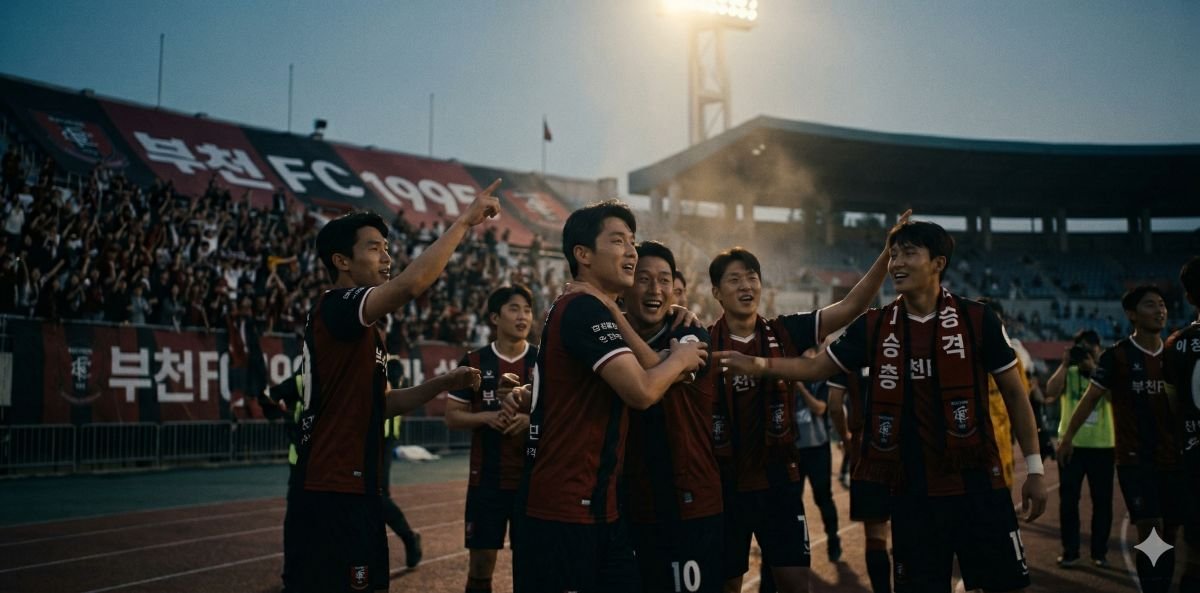
Bucheon FC 1995 has made history by reaching K League 1 for the first time in the club’s existence. For fans unfamiliar with how Korean professional football is structured, this moment offers the most locally grounded, concrete way to understand what promotion actually means — and why it carries weight far beyond a number on a standings table.
A Club Born from Loss
The story of Bucheon FC 1995 does not begin with a trophy or a transfer. It begins with a city losing its team.
In early 2006, Bucheon SK relocated to Jeju Island, leaving behind a fanbase with no club to call their own. Within weeks, a group of former Bucheon SK supporters decided they would not simply move on. They began organizing, fundraising, and building something new from nothing. By December 2007, Bucheon FC 1995 was officially founded — a community-owned club whose name carries the year 1995, the year the predecessor club first arrived in Bucheon.
That founding story matters when thinking about promotion. This is not a franchise relocated by a corporation or a club backed by a conglomerate. Bucheon FC 1995 was built by the people who felt the absence of football most keenly. When a club like that reaches the top tier of Korean professional football, it is not just a sporting result. It is the completion of something that started the moment a city decided to rebuild.
What the Promotion and Relegation System Actually Is
For a reader encountering Korean professional football for the first time, the structure can seem complicated. It does not have to be.
Korean professional football operates across two primary divisions. K League 1 is the top tier, featuring the country’s most competitive clubs including Jeonbuk Hyundai, FC Seoul, and Ulsan HD. K League 2 sits directly below it — a fully professional second division where clubs compete each season for the chance to rise.
At the end of every K League 2 season, the top two finishers earn automatic promotion to K League 1 the following year. Below those automatic spots, additional promotion places are decided through a multi-team playoff series. The winners of those playoffs claim the final available spot in the top division. Meanwhile, clubs finishing at the bottom of K League 1 face the opposite journey — either automatic relegation to K League 2 or a high-stakes playoff to preserve their status.
This system means that every match in every round carries direct consequences. A result in March can influence whether a club is playing in front of ten thousand fans the following season or forty thousand. The league table is not just information — it is a live mechanism that determines which division a club occupies next year.
Bucheon FC 1995 joined K League 2 in 2013 and spent more than a decade competing in the second tier. For years, the club never even reached the promotion playoffs. That changed in 2025, when Bucheon navigated the playoff series and defeated Suwon FC across two legs, winning 4-2 on aggregate to claim their place in K League 1 for the first time in the club’s history.
What Actually Changes When a Club Gets Promoted
Promotion is not simply a change of label. It reshapes almost every dimension of how a football club operates.
The competition level rises sharply. In K League 2, Bucheon were regularly among the stronger sides. In K League 1, they enter a division where every opponent has been competing at the highest domestic level. The margins for error are smaller, the opponents more experienced, and the tactical demands more complex across a full season.
The fixture schedule becomes more demanding. K League 1 clubs play against a broader range of opponents with less margin to rotate or recover. Squad depth, fitness management, and coaching quality are all tested more severely across the course of a campaign.
The club’s operational scale expands. Higher division football brings larger crowds, greater media exposure, and more revenue potential. For a citizen-owned club like Bucheon, that increase in visibility also comes with greater scrutiny and higher expectations from a growing supporter base.
For fans, the experience changes entirely. Away trips now mean visits to some of the most recognizable stadiums in Korean football. Home matches draw more attention from national media. The club becomes part of conversations that previously happened without them.
The First Match and What It Signaled
Bucheon FC 1995’s opening K League 1 fixture delivered something that exceeded even the most optimistic expectations. Facing defending champions Jeonbuk Hyundai away at Jeonju World Cup Stadium, Bucheon fell behind early but refused to collapse. They came from behind to win 3-2, with Jefferson Galego scoring what became the first K League 1 goal in the club’s history.
A comeback victory on the road against the reigning champions, in the very first match at the highest level — that result told the Korean football world that Bucheon had not arrived simply to participate.
Why This Story Matters Beyond Football
Promotion means different things depending on who is watching. For a neutral observer, it is a structural outcome produced by a playoff result. For a Bucheon fan who has followed this club since it was founded in a room full of people who refused to give up on their city’s football, it is the proof that the entire journey was worth it.
Understanding the promotion and relegation system is the entry point. But the deeper lesson that Bucheon FC 1995 offers is that the system exists to reward exactly this kind of persistence — clubs that build from the ground up, compete honestly, and earn their place through performance rather than investment alone.
For a fuller breakdown of how K League’s tier structure works from the bottom up, the guide at What Does Promotion to K League 1 Actually Mean walks through the full format in plain language. For analytical context on why handicap market structures exist in tiered competition systems, 핸디캡 마켓이 존재하는 이유 provides useful structural framing.
Bucheon FC 1995’s story in K League 1 is only beginning. The promotion was the destination for seventeen years of effort. What comes next is the competition itself.