

Understanding the K League 2 “1+2” Promotion System: A Guide for Bucheon Fans

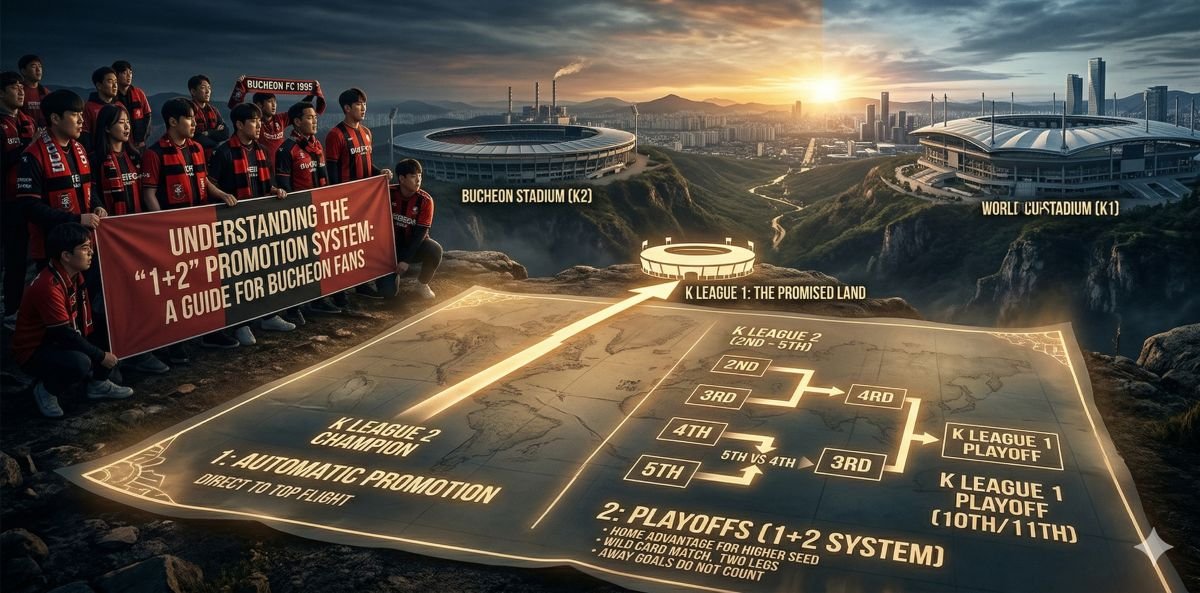
For residents of Bucheon and the wider Gyeonggi-do region, the local football club—Bucheon FC 1995—is more than just a team; it is a point of civic pride and a central pillar of local sports culture. However, for those new to following the “Red Wolves” or the K League in general, the end-of-season standings can be a source of significant confusion.
While many of the world’s most famous football leagues, such as the English Premier League or the German Bundesliga, operate on a relatively simple “top three up, bottom three down” model, South Korea’s K League utilizes a more complex “1+2” promotion-relegation system. This structure is designed to balance seasonal consistency with the high-stakes drama of tournament play. Understanding this system is essential for any fan who wants to interpret the true stakes of a mid-season match at Bucheon Stadium.
The “1+2” Philosophy: Stability Meets Drama
The term “1+2” refers to the number of potential promotion slots available to K League 2 clubs. In this framework, only one team is guaranteed a spot in the top flight (K League 1), while two other spots must be fought for through a series of grueling playoff matches.
This system was implemented to ensure that the K League 1 remains highly competitive while providing K League 2 teams with multiple pathways to ascent. For a club like Bucheon FC 1995, this means that even if the top spot feels out of reach by mid-summer, the season is far from over. As long as the team remains in the top five, the dream of promotion stays alive.
1. The Direct Route: The K League 2 Champions
The first path is the most straightforward. The team that finishes the regular season in 1st place in K League 2 receives automatic promotion. There are no playoffs or secondary hurdles for the champion; they simply swap places with the 12th-placed (last) team in K League 1.
For fans, this makes the race for the league title incredibly intense. The difference between finishing 1st and 2nd is not just a trophy—it is the difference between a guaranteed promotion and entering a volatile playoff “lottery” where one bad afternoon can end a year’s worth of progress.
2. The K League 2 Playoff: The “Ladder” Format
The second path involves the teams that finish between 2nd and 5th place. This is where the K League’s unique “ladder” system comes into play. Instead of a standard semi-final bracket, the K League uses a staggered knockout format that rewards teams for their higher regular-season finish.
The Semi-Playoff: The 4th-placed team hosts the 5th-placed team in a single-elimination match.
The Playoff: The winner of the 4th vs. 5th match moves on to play the 3rd-placed team.
The Final Hurdle: The winner of that match then faces the 2nd-placed team.
The team that survives this internal K League 2 gauntlet does not get promoted immediately. Instead, they earn the right to participate in the final Promotion-Relegation Playoff against a top-tier opponent. This “ladder” design is a fascinating study in how legal structures shape user behavior, as it forces teams to fight for every single point in the regular season to secure a higher rung on the ladder, which requires fewer playoff matches to advance.
3. The Promotion-Relegation Playoffs: The Inter-League Clash
The final stage of the “1+2” system involves two separate home-and-away series that determine the final makeup of K League 1 for the following season:
Series A: The 2nd-placed team from K League 2 faces the 11th-placed team from K League 1.
Series B: The winner of the K League 2 “ladder” playoffs faces the 10th-placed team from K League 1.
These matches are played over two legs (home and away). This format is designed to mitigate the element of luck, ensuring that the team that eventually earns the K League 1 spot has demonstrated superior skill and tactical depth over 180 minutes of play.
Why the System Matters for the Bucheon Community
For the Bucheon faithful, this system creates a unique psychological environment. In a traditional league, a team sitting in 5th place with ten games to go might be viewed as having “nothing left to play for.” In the K League, however, 5th place is a vital threshold.
The “1+2” system ensures that the “middle class” of the league remains engaged. It prevents the mid-season stagnation that can occur when the gap between the top two teams and the rest of the field becomes too wide. For an entry-level fan, it is important to realize that a draw in September might feel like a minor result, but in the context of the 5th-place cutoff, it could be the difference between an early vacation and a historic promotion run.
To truly grasp the impact of these movements, fans can benefit from understanding what does promotion to K League 1 actually mean, which details the administrative, financial, and cultural shifts that occur when a club jumps between tiers.
Summary of the “1+2” Impact
The K League’s promotion structure is a sophisticated piece of sports engineering. By combining the meritocracy of a long-form season (the Direct Route) with the localized intensity of tournament play (the Playoff Ladder), the league maintains a high level of engagement across its entire fan base.
For those attending matches in Bucheon or following along online, keeping one eye on the 1st-place gap and the other on the 5th-place boundary is the only way to truly understand the pulse of the season. As the league enters its final months, every goal is a calculation, and every point is a step toward the top flight.