

K League 1 Split System Explained: Why 2026 Is the Final Season of a Format That Shaped Korean Football

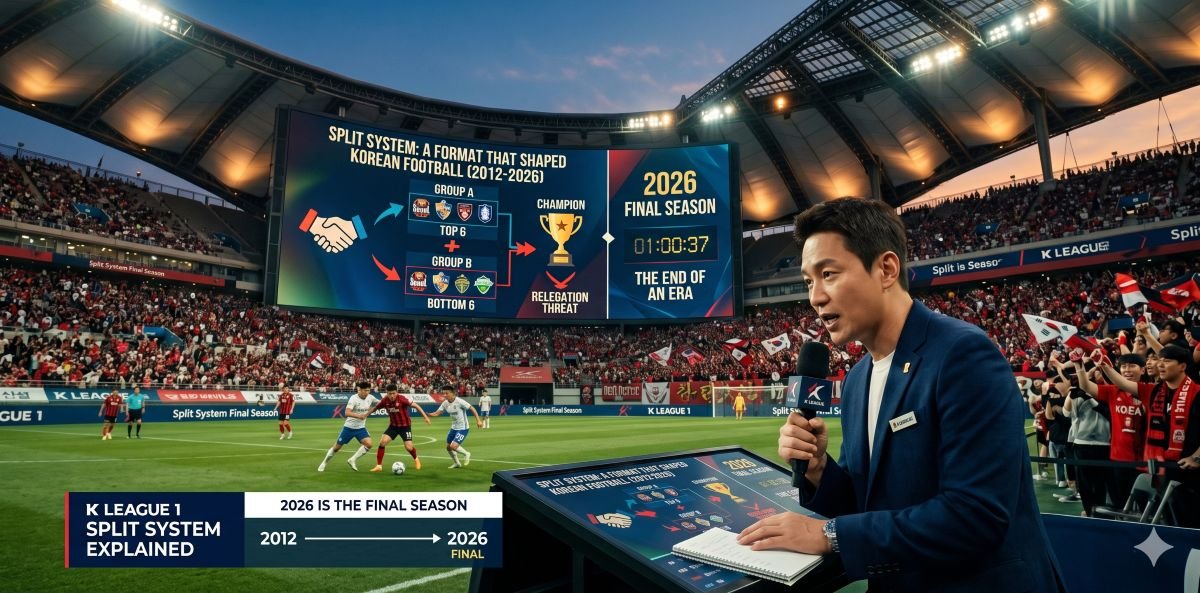
If you have recently started following Korean football — perhaps prompted by Bucheon FC 1995’s historic first promotion to the top flight — one of the first things that will confuse you is the phrase “the split.” Unlike most football leagues around the world, where the season runs from start to finish in a single table, K League 1 divides itself partway through. Understanding how this works is essential to following the 2026 season, and the timing matters more than usual: this is the last year the split system will ever exist.
What the Split System Actually Is
K League 1 currently operates with 12 clubs. Every team plays every other team three times during what is called the regular season, producing 33 rounds of fixtures. After those 33 rounds are complete, the table is frozen and the league divides into two groups based on where each club sits.
The top six teams enter what is called Final A — sometimes referred to as the Championship Group. The bottom six enter Final B, also called the Relegation Group. Each group then plays a further five rounds, with every team in that group meeting every other team in the group once more. Those additional five rounds are commonly called the “post-split” fixtures.
Points from the regular season carry forward completely. A club that finishes the 33-round phase in third place does not start the Final A stage on zero points. Whatever they accumulated over the full regular season stays on the table, and the five additional matches are simply added on top. Final standings after all 38 rounds are complete determine everything: the title, European qualification, and relegation.
What Final A and Final B Actually Decide
For clubs in Final A, the five post-split matches determine where teams finish in the top half of the table. The K League 1 champion earns a place in the AFC Champions League Elite. The runners-up and third-place finisher also qualify for continental competition, with specific tier allocation depending on Korea Cup results. These are meaningful distinctions, as AFC competition represents significant financial and reputational value for clubs.
For clubs in Final B, the stakes are more immediate. The club finishing 12th — last place overall — faces relegation to K League 2. In 2026, there is a structural nuance: Gimcheon Sangmu, the military-affiliated club, will be relegated regardless of where they finish because their hosting agreement with Gimcheon City expires at the end of this season. This means the clubs occupying 10th and 11th place face promotion-relegation playoff exposure only if Gimcheon does not finish last.
For a newly promoted club like Bucheon FC 1995 — competing in K League 1 for the first time in the club’s modern history — understanding this distinction is important. As explained in Bucheon FC 1995’s promotion journey and what it means for the club’s first season in K League 1, Bucheon’s immediate priority is survival, and the post-split structure means there is a natural checkpoint at round 33 where the picture becomes clearer. Finishing in the top six would be an extraordinary achievement; finishing outside the relegation zone within Final B would represent a successful debut campaign.
Why the System Was Introduced — and Why It Is Ending
The split system was first introduced in 2012 when K League 1 had 16 teams. The rationale was straightforward: by dividing the league after the bulk of the schedule, every club still has meaningful matches late in the season. Clubs in a traditional single-table format can mathematically secure mid-table safety weeks before the season ends, leaving dead rubbers that damage attendance and television interest. The split eliminates this by ensuring Final A clubs play for title and European positioning right up to the final round, while Final B clubs fight relegation until the very end.
It was a format designed for a specific competitive environment, and it worked reasonably well for over a decade. According to K League’s official competition structure documentation, the split has operated continuously since its introduction, surviving multiple changes in team numbers and league formatting.
The reason it is ending is simple arithmetic. From 2027, K League 1 expands to 14 teams. With 14 clubs, a split into groups of seven produces a post-split schedule where every team plays six additional matches against teams in their half — more than the five played now, but with different fixture mathematics. The K League federation has determined that moving to three full round robins across all 14 teams produces a cleaner, more equitable format. Every team plays every other team three times, producing 39 rounds total, with no division of the table.
What This Means for the 2026 Season
Anyone watching K League 1 in 2026 is witnessing the format in its final iteration. The split — with all of its tactical implications, the psychological shift when teams know which group they are entering, and the unique drama of clubs on the bubble at round 33 — disappears after this season permanently.
For Bucheon supporters following their club’s first K League 1 campaign, the split creates a natural narrative arc. The first 33 rounds are about establishing enough points to avoid the danger zone. The final five rounds, whatever group Bucheon enters, will determine where the club finishes and whether their first top-flight season ends with stability or anxiety. It is a format with built-in drama at every stage — and 2026 is the last time Korean football will run it.