
Understanding the K League Split System and the 2026 Finale

The 2026 K League 1 season represents a significant milestone for football fans in South Korea. It is a year of transition, marking the final time the league will use its signature split system before a major expansion in 2027. For anyone new to the league, the current structure can feel a bit like a puzzle. Unlike many European leagues where teams play each other a set number of times and the table stays as one unit, the K League adds a twist in the final stretch of the season. Understanding this format is key to following the drama of the current year, especially as the league prepares for a new era.

The Mechanics of the Split

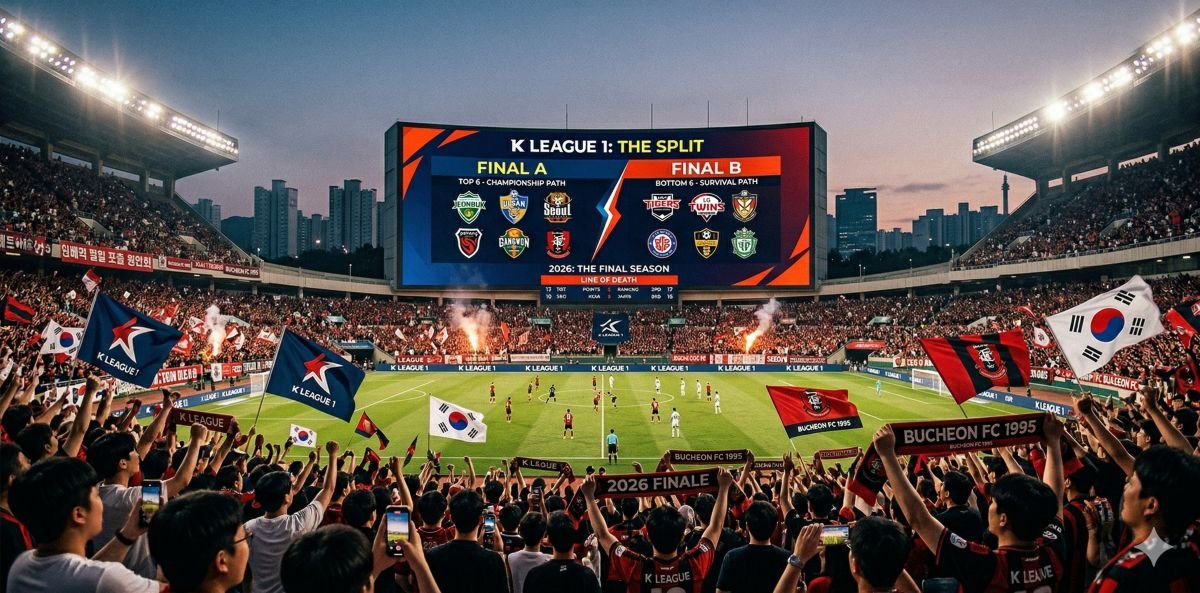
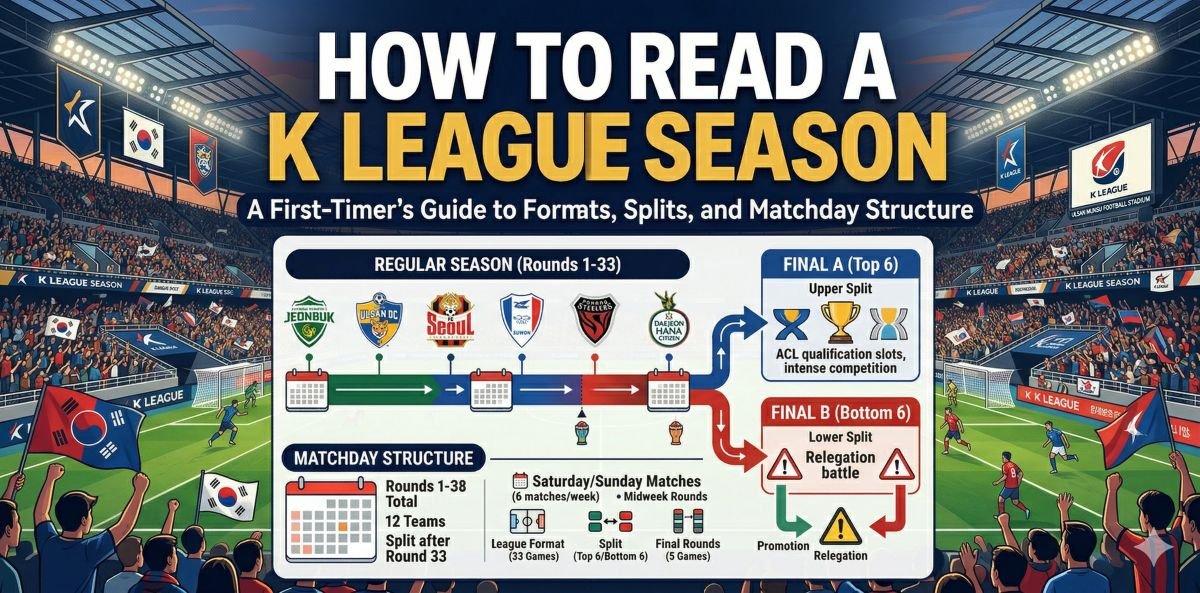
At its core, the split system is a way to divide the twelve teams of K League 1 into two distinct groups during the latter part of the season. The league begins with a regular season where every team plays each other three times, totaling thirty-three matches. Once these games are completed, a line is drawn through the middle of the standings. This is often called the Line of Death by fans because it determines a club’s fate for the rest of the year.

The teams ranked from first to sixth move into a group called Final A. These clubs compete for the league title and qualification for continental tournaments like the AFC Champions League. The teams ranked from seventh to twelfth move into Final B. Their primary goal shifts to survival, as they fight to avoid relegation to the K League 2.

A crucial point for new observers is that points earned during the first thirty-three matches carry over into the final stage. However, once the split happens, a team in Final B cannot move up into Final A, even if they end the season with more total points than a team in the top half. This creates two separate mini-leagues for the final five matches of the year.

Read also: How to Read a K League Season: A First-Timer’s Guide to Formats, Splits, and Matchday Structure

A History of Change

The split system was not always part of Korean football. It was introduced in 2012 when the division had sixteen teams. At that time, the league was looking for ways to increase the intensity of matches and ensure that every game had something at stake. In the years that followed, the number of teams in the top flight fluctuated, moving to fourteen teams in 2013 and eventually settling on the twelve-team format that fans know today.

Over the last decade, the system has provided high levels of drama. Because Final B teams only play against other teams facing relegation, those matches often feel like cup finals. Similarly, every game in Final A is a high stakes encounter between the top clubs in the country. While the system can be confusing at first, it was designed to prevent teams in the middle of the table from having nothing to play for in the final weeks.

Bucheon FC 1995 and the 2026 Milestone

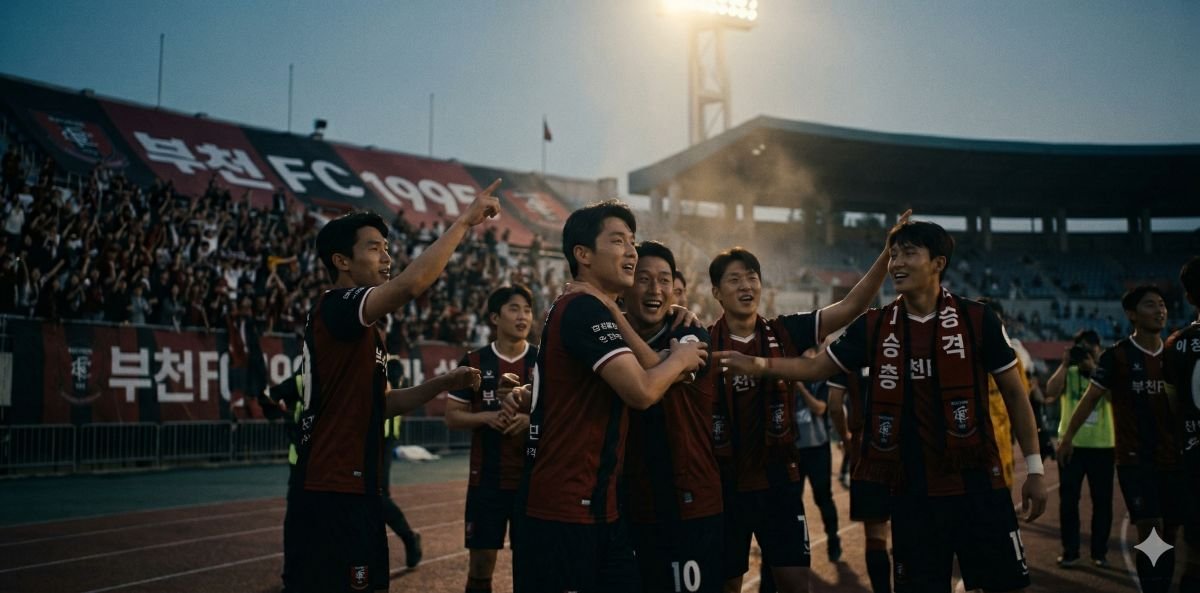
The 2026 season is particularly special for Bucheon FC 1995. This year marks the first time the club has ever competed in K League 1. Known to their fans as the Reds, Bucheon joined the top tier after a successful promotion campaign, following in the footsteps of clubs like Suwon FC and FC Anyang.

For Bucheon and their supporters, 2026 is a unique opportunity to experience the split system before it disappears. As the new kids in the league, their primary focus will likely be securing a spot in the top half or fighting for every point in Final B. Their presence adds a fresh narrative to the final year of this format, giving a local community a chance to engage with the structural quirks that have defined the league for over a decade.

Why the System is Ending

The decision to move away from the split system is tied to the expansion of K League 1. Starting in the 2027 season, the top division will grow from twelve clubs to fourteen. This expansion is a result of the growing health and popularity of professional football in South Korea.

To reach that fourteen-team goal, the 2026 promotion and relegation rules are quite specific. The top two teams from K League 2 will earn automatic promotion to the 2027 top tier. Additionally, the winner of a final promotion playoff will also move up. This path to expansion makes the split system logistically difficult to maintain. With fourteen teams, a split would create odd numbers or require a schedule that is too long for the calendar.

What Happens in 2027

When the 2027 season kicks off, fans will see a more traditional league structure. The fourteen teams will compete in three round robins. This means every team will play each other three times, and the final standings will be determined by the single, unified table after all matches are finished.

This move toward a larger, more conventional league reflects a desire for stability and simplicity. It allows for a straightforward narrative where every team’s position is always relative to everyone else in the league. While the split system brought a unique energy to the end of the season, a fourteen-team league provides a broader representation of cities and regions across Korea.

The Final Drama of 2026

For the fans currently filling stadiums in 2026, the focus remains on the present. The upcoming split in the latter half of the year will be the final time that the Line of Death is drawn. It is a chance to celebrate the intensity that this format has provided since 2012.

As teams like the LG Twins and Kia Tigers continue their traditional rivalries, and newcomers like Bucheon FC 1995 find their footing, the structural change looms in the background. The end of the split system is a sign of progress, marking the moment when the K League outgrows its current clothes and moves into a larger stadium. For now, supporters can enjoy the specific tension of Final A and Final B one last time, knowing that they are witnessing a closing chapter in the history of the sport.
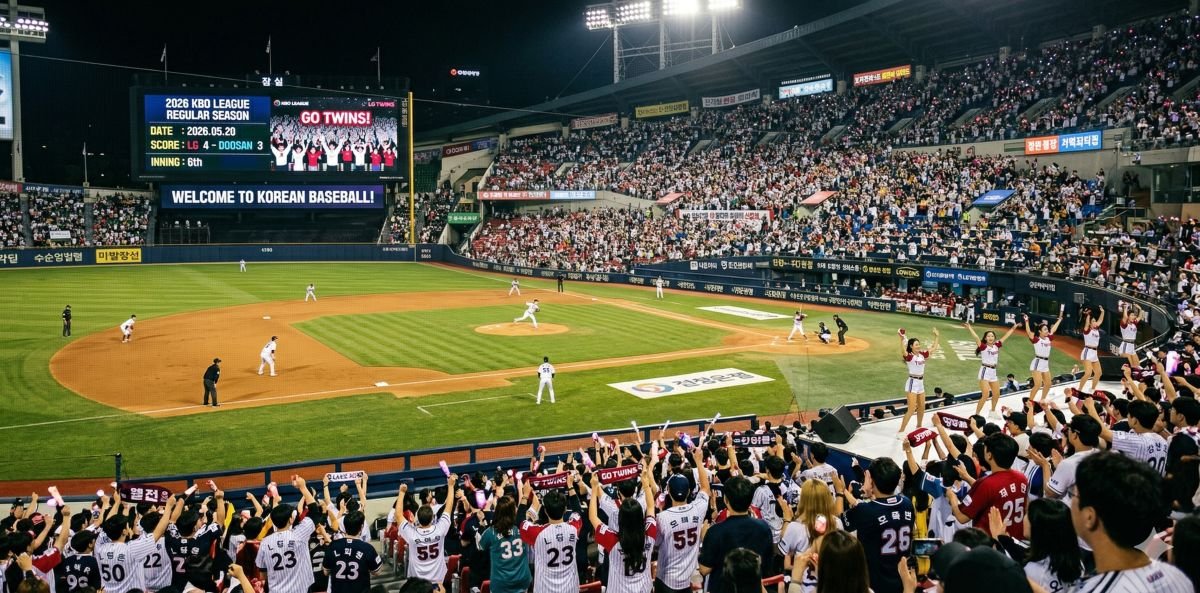
How the KBO League Season Works — A Beginner’s Guide to Korean Baseball in 2026

The 2026 KBO League season is underway, and for first-time followers in Bucheon, Suwon, and across Gyeonggi-do, the sheer number of games, the unfamiliar playoff format, and the new rules introduced this year can make the sport feel more complicated than it needs to be. This guide breaks it all down from the beginning.

What the KBO League Is

The Korea Baseball Organization League — universally known as the KBO — is South Korea’s top professional baseball competition. Founded in 1982 with six teams, the league has grown to its current format of ten clubs competing across a full season that runs from late March through October. The 2026 season is the 45th edition of the competition, and it is the most widely followed domestic sport in the country by attendance.

The ten clubs are spread across South Korea’s major cities. Fans in the Gyeonggi-do region often follow teams based in nearby Seoul and Incheon, including the LG Twins, Doosan Bears, and SSG Landers, though every club has a national following that tracks games online and through broadcast.

The Regular Season: Nearly Daily Baseball for Six Months

The KBO regular season is long and dense by design. The 2026 season began on March 28 and runs through September 6. During that window, each of the ten teams plays 144 games — facing every other team in the league 16 times across the schedule. Games are played every day of the week except Mondays, which function as the league’s universal rest day.

For a new fan, this schedule density is often the first surprise. Korean professional baseball is not a weekend event. It is a near-daily fixture in the sports calendar for six months straight. A team might play a three-game series in Daejeon, travel to Busan for three more, and return home for a weekend set — all within a single week.

This structure means the standings shift constantly. A team that looks dominant in April might cool significantly by July, and a club that starts poorly can rebuild its position across the long haul of the season. The volume of games is what makes the KBO standings a genuinely meaningful indicator of quality — random results average out over 144 games in a way they simply cannot over 30 or 40.

How the Postseason Works: A Step-Ladder System

At the end of the regular season, the top five teams by win-loss record advance to the postseason. This is where the format becomes distinctive.

The KBO postseason uses a step-ladder structure, meaning teams enter the competition at different points depending on where they finished in the regular season. The team that finishes fifth plays the fourth-place team in a Wild Card Game, where the fourth-place side begins with a built-in advantage — they need only one win to advance, while the fifth-place team must win twice.

The winner of the Wild Card Game then plays the third-place team in a best-of-three Semi-Playoff series. The winner of that series advances to face the second-place team in a best-of-five Playoff series. Finally, the winner of the Playoff series meets the regular season champions — the team that finished first — in the Korean Series, a best-of-seven championship that determines the year’s title.

This structure rewards regular season performance directly. Finishing first means sitting out the early rounds entirely and entering fresh against a team that has already played multiple elimination games. Finishing fifth means surviving the most dangerous gauntlet, needing to beat three separate opponents just to reach the championship round.

What Changed for 2026: The Pitch Clock and the Asian Quota

Two rule changes introduced for 2026 are worth understanding because they directly affect how games feel and how rosters are built.

The first is the pitch clock adjustment. In 2025, the KBO introduced a pitch clock for the first time — a timer that limits how long pitchers can take between deliveries. That change immediately shortened average game times to three hours and two minutes, the fastest average since the year 2000. For 2026, the KBO tightened the clock further. Pitchers must now begin their delivery within 18 seconds when the bases are empty, reduced from 20 seconds, and within 23 seconds with runners on base, down from 25. The intent is to keep the pace of play moving and prevent the extended dead time between pitches that used to stretch games well past three hours.

The second change involves roster composition. Previously, each KBO team could sign up to three foreign players. In 2026, that limit increased to four — but the additional slot is specifically reserved for players from Asian countries, under what the league calls the Asian Quota System. This change opens the door for players from Japan, Taiwan, and other Asian baseball markets to join KBO rosters more easily, expanding the international character of the league.

How to Follow the Season as a New Fan

The simplest entry point for a new KBO fan is the standings. Checking where a team sits in the ten-team table after each week gives an immediate sense of the season’s shape. As the September 6 end date approaches, the race for the final postseason spots tends to produce some of the most competitive and closely watched games of the entire year.

For context on how Korean sports leagues structure their seasons and what the tier system means for competition format, How to Read a K League Season offers a useful parallel guide focused on football that applies many of the same structural concepts.

Understanding variance and why a single result rarely tells the full story of a team’s quality is one of the deeper lessons that long-format leagues like the KBO teach naturally over time. The foundational logic behind that concept is explored in 왜 강팀도 자주 패배하는가 — a useful analytical companion to following any high-volume sports competition.

The KBO season is long for a reason. The format is designed to reward consistency, expose weakness, and produce a champion that has genuinely earned the title across 144 games and a demanding postseason gauntlet. For a first-time follower, the best approach is simply to pick a team and start watching. The structure will make more sense with every week that passes.

What It Means When a Club Gets Promoted: Understanding Bucheon FC 1995’s Historic Arrival in K League 1

Bucheon FC 1995 has made history by reaching K League 1 for the first time in the club’s existence. For fans unfamiliar with how Korean professional football is structured, this moment offers the most locally grounded, concrete way to understand what promotion actually means — and why it carries weight far beyond a number on a standings table.

A Club Born from Loss

The story of Bucheon FC 1995 does not begin with a trophy or a transfer. It begins with a city losing its team.

In early 2006, Bucheon SK relocated to Jeju Island, leaving behind a fanbase with no club to call their own. Within weeks, a group of former Bucheon SK supporters decided they would not simply move on. They began organizing, fundraising, and building something new from nothing. By December 2007, Bucheon FC 1995 was officially founded — a community-owned club whose name carries the year 1995, the year the predecessor club first arrived in Bucheon.

That founding story matters when thinking about promotion. This is not a franchise relocated by a corporation or a club backed by a conglomerate. Bucheon FC 1995 was built by the people who felt the absence of football most keenly. When a club like that reaches the top tier of Korean professional football, it is not just a sporting result. It is the completion of something that started the moment a city decided to rebuild.

What the Promotion and Relegation System Actually Is

For a reader encountering Korean professional football for the first time, the structure can seem complicated. It does not have to be.

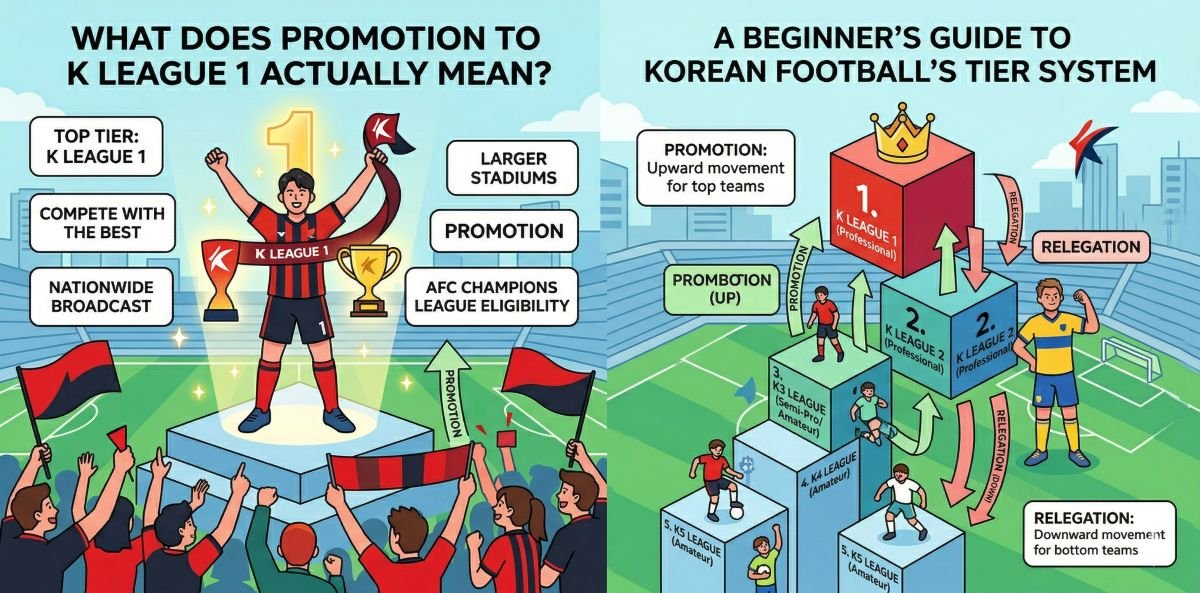
Korean professional football operates across two primary divisions. K League 1 is the top tier, featuring the country’s most competitive clubs including Jeonbuk Hyundai, FC Seoul, and Ulsan HD. K League 2 sits directly below it — a fully professional second division where clubs compete each season for the chance to rise.

At the end of every K League 2 season, the top two finishers earn automatic promotion to K League 1 the following year. Below those automatic spots, additional promotion places are decided through a multi-team playoff series. The winners of those playoffs claim the final available spot in the top division. Meanwhile, clubs finishing at the bottom of K League 1 face the opposite journey — either automatic relegation to K League 2 or a high-stakes playoff to preserve their status.

This system means that every match in every round carries direct consequences. A result in March can influence whether a club is playing in front of ten thousand fans the following season or forty thousand. The league table is not just information — it is a live mechanism that determines which division a club occupies next year.

Bucheon FC 1995 joined K League 2 in 2013 and spent more than a decade competing in the second tier. For years, the club never even reached the promotion playoffs. That changed in 2025, when Bucheon navigated the playoff series and defeated Suwon FC across two legs, winning 4-2 on aggregate to claim their place in K League 1 for the first time in the club’s history.

What Actually Changes When a Club Gets Promoted

Promotion is not simply a change of label. It reshapes almost every dimension of how a football club operates.

The competition level rises sharply. In K League 2, Bucheon were regularly among the stronger sides. In K League 1, they enter a division where every opponent has been competing at the highest domestic level. The margins for error are smaller, the opponents more experienced, and the tactical demands more complex across a full season.

The fixture schedule becomes more demanding. K League 1 clubs play against a broader range of opponents with less margin to rotate or recover. Squad depth, fitness management, and coaching quality are all tested more severely across the course of a campaign.

The club’s operational scale expands. Higher division football brings larger crowds, greater media exposure, and more revenue potential. For a citizen-owned club like Bucheon, that increase in visibility also comes with greater scrutiny and higher expectations from a growing supporter base.

For fans, the experience changes entirely. Away trips now mean visits to some of the most recognizable stadiums in Korean football. Home matches draw more attention from national media. The club becomes part of conversations that previously happened without them.

The First Match and What It Signaled

Bucheon FC 1995’s opening K League 1 fixture delivered something that exceeded even the most optimistic expectations. Facing defending champions Jeonbuk Hyundai away at Jeonju World Cup Stadium, Bucheon fell behind early but refused to collapse. They came from behind to win 3-2, with Jefferson Galego scoring what became the first K League 1 goal in the club’s history.

A comeback victory on the road against the reigning champions, in the very first match at the highest level — that result told the Korean football world that Bucheon had not arrived simply to participate.

Why This Story Matters Beyond Football

Promotion means different things depending on who is watching. For a neutral observer, it is a structural outcome produced by a playoff result. For a Bucheon fan who has followed this club since it was founded in a room full of people who refused to give up on their city’s football, it is the proof that the entire journey was worth it.

Understanding the promotion and relegation system is the entry point. But the deeper lesson that Bucheon FC 1995 offers is that the system exists to reward exactly this kind of persistence — clubs that build from the ground up, compete honestly, and earn their place through performance rather than investment alone.

For a fuller breakdown of how K League’s tier structure works from the bottom up, the guide at What Does Promotion to K League 1 Actually Mean walks through the full format in plain language. For analytical context on why handicap market structures exist in tiered competition systems, 핸디캡 마켓이 존재하는 이유 provides useful structural framing.

Bucheon FC 1995’s story in K League 1 is only beginning. The promotion was the destination for seventeen years of effort. What comes next is the competition itself.

How to Read a K League Season: A First-Timer’s Guide to Formats, Splits, and Matchday Structure

The 2026 K League 1 season marks the final chapter of a format that has defined Korean top-flight football since 2012 — a 12-team split system with a Final A and Final B structure that will be replaced from 2027 by an expanded 14-team league. For new supporters following Bucheon FC 1995’s debut in the top flight, understanding what a “split” means, how points carry over, and what the season’s phases actually look like can be genuinely confusing. Here is a plain-language breakdown of how a K League 1 season works from first matchday to final whistle.

The Basic Shape of a Season

A K League 1 season does not run like most European leagues, where teams simply play home-and-away fixtures until a final table is produced. The Korean top flight uses a two-phase format: a regular season followed by a split phase.

The K League 1 season is played over 38 rounds — 33 as part of the regular season and five in the K League “Final.” The 12 teams play each other three times pre-split and then one more time post-split.

That asymmetry — three encounters between clubs in the regular season rather than two — is what makes the K League format feel unfamiliar to supporters used to other leagues. When 12 teams each play one another three times, the total comes to 33 rounds. After those 33 matchdays are complete, the split begins.

What the Split Actually Means

The split is the mechanism that divides the league into two separate groups for the final five rounds of the season. Each club plays each other three times in the regular round, then the top and bottom six teams are split into Split A and Split B, in which a team plays every other team in the split once, to decide the final standings.

In everyday K League language, Split A is called Final A and Split B is called Final B.

The top six teams contest Final A, playing each other once. The bottom six teams contest Final B, also playing each other once. The key point here is that points accumulated from the regular season are carried over into the split phase. No points are reset. A team that enters the split with 55 points continues from 55 points. The five additional matches simply add to what has already been earned.

This means the split does not create a clean second competition — it is a continuation of the same table, with clubs now confined to playing only opponents from their own group.

What Is at Stake in Each Group

The two groups serve entirely different competitive purposes, and that is by design.

Final A teams are playing for three spots in the AFC Champions League. Final B teams are playing to avoid the bottom two spots, with the last-placed team facing automatic relegation to K League 2, and the 11th-placed team contesting the promotion-relegation playoff with a K League 2 opponent.

The K League 1 title winners qualify for the AFC Champions League Elite, as do the Korea Cup winners if they also finish in the top four. The K League 1 runners-up also earn an AFC Champions League Elite place, while third place qualifies for AFC Champions League Two.

There is one other structural detail worth noting for Bucheon supporters specifically: a team that qualifies for Final A is guaranteed to finish no lower than sixth place in the league. Even if a Final B team ends up with a higher point total than a Final A team at the end of the season, they will finish no higher than seventh place. Finishing position, in other words, is locked once the split is determined.

Points and Tiebreakers

Points are awarded with three for a victory, one for a draw, and zero for a defeat, accumulating to rank teams throughout the season.

When clubs are level on points, the K League uses a specific tiebreaker sequence. The rules for classification are: first, points; second, goals scored; third, goal difference; fourth, wins; fifth, head-to-head points. This differs from most European leagues, which prioritise goal difference over goals scored — a detail that can affect how clubs approach matches late in the season.

For a more detailed look at how sports league structures and their statistical frameworks affect competitive outcomes, daejeoninsider.com has a useful overview of sports analysis methodology and how structural factors are evaluated.

The Matchday Experience

The K League 1 season typically begins in late February and the league goes on a World Cup break from the end of May to early July. Matchdays are generally held across weekends, with some midweek fixtures scheduled around AFC Champions League commitments and cup competitions.

The Korea Cup runs alongside the league season. From 2026, the Korea Cup is switching to an autumn-spring format, with the early rounds taking place in July and August 2026, and the quarterfinals through the final held in May and June 2027. For supporters attending matches, this means a busy calendar with cup fixtures interspersed between league rounds.

Matchday squads in K League 1 consist of 20 players. Clubs will now have five substitutions in 2026, and the U22 mandatory appearance rule has been lifted, though at least two U22 players must still be named in the matchday squad.

Why 2026 Is the Last Season of This Format

The 2026 season will be the last of a 12-team K League 1 and will see the end of the split, Final A and Final B system. From 2027, K League 1 will have 14 teams with three round robins.

The split system came into effect in 2012 in what was a 16-team K League 1, then a 14-team division in 2013, before becoming the 12-team league it is today the following year. For more than a decade, Final A and Final B have structured the Korean football season’s defining weeks. From 2027, that framework gives way to a simpler three-round-robin structure across a larger field of clubs.

For Bucheon FC supporters experiencing top-flight football for the first time, understanding how that timeline and league structure connects to their club’s journey is worth exploring further. Bucheon Insider has context on how league governance shapes market availability and the competitive conditions clubs face.

Bucheon’s debut K League 1 season arrives in what is simultaneously the format’s final year and the most structurally forgiving environment for a newly promoted side. Knowing how the season is built — round by round, split by split — is the first step to following it properly.

What Does Promotion to K League 1 Actually Mean? A Beginner’s Guide to How Korean Football’s Tier System Works

Bucheon FC 1995 earned promotion to K League 1 for the first time in the club’s history after defeating Suwon FC in the promotion-relegation playoff — and for many new fans in Bucheon, that moment raised a straightforward but important question: what exactly just happened, and why does it matter so much?

Bucheon FC defeated Suwon FC 3-2 in the second leg of their K League promotion-relegation playoff, capturing the series 4-2 on aggregate. The scenes that followed were extraordinary. But to understand why this result sent shockwaves through Korean football — and why Bucheon’s fanbase had been waiting nearly two decades for this moment — it helps to first understand how the K League system is actually structured.

How the K League Tier System Works

Korean professional football operates across two main divisions. Below K League 1 is the second-tier K League 2, and both form the K League as professional championships. Under them sit two semi-professional leagues — the K3 and K4 Leagues — and three amateur leagues below those.

K League 1 is the country’s top flight. Competing there means facing the strongest clubs in South Korea — larger squads, bigger budgets, and stadiums with greater matchday atmosphere. On 22 January 2018, the top-flight competition was officially renamed K League 1. It has been the proving ground for Korean football since the league’s founding in 1983.

K League 2, by contrast, is where clubs develop, rebuild, or spend years without breaking through. After joining the second-tier K League 2 in 2013, Bucheon had never even competed in promotion-relegation playoffs until the 2025 season. That is more than a decade of professional football without once reaching the moment that defines a club’s ambitions.

What Promotion and Relegation Actually Mean

Promotion and relegation are the mechanisms that allow clubs to move between tiers based on performance. A club that finishes at the top of K League 2 earns the right to compete in K League 1 the following season. A club that finishes at the bottom of K League 1 drops down to K League 2.

The K League promotion-relegation playoffs were introduced in 2013 and are contested between clubs finishing in the lower positions of K League 1 and the higher positions of K League 2. The first leg is always played at the second division team’s home ground, while the second leg is played at the first division team’s home ground.

This format produces some of the most dramatic moments in Korean football. The two-legged structure means a club must perform across two matches — often in hostile environments — to either secure a place in the top flight or defend an existing one. If teams are tied on aggregate after 90 minutes in the return fixture, extra time applies, though away goals do not count.

For a broader look at how settlement rules and match outcomes are handled across different sporting contexts, bucheoninsider.com has a useful breakdown on why settlement rules differ by sport.

The Road Bucheon FC Took to Get Here

Understanding what Bucheon achieved requires understanding the specific route they navigated in 2025. They did not earn automatic promotion by winning the K League 2 title outright. Instead, Bucheon finished third in the regular season — their highest-ever finish — before defeating K League 1 side Suwon FC in the promotion-relegation playoffs.

The route through the playoffs for a third-place K League 2 side is not straightforward. They must first navigate internal K League 2 playoff rounds before reaching the cross-division series against a K League 1 opponent. What set Bucheon apart was their steely determination to get the job done. They were ready for Suwon FC — confident, in-form, and in possession of a squad that had grown consistently throughout the campaign.

Bucheon finished the regular season with 19 wins and 67 points, with midfielder Takahashi Kazuki pointing to strong scouting and a fast start as the foundation of their successful campaign.

What Changes When a Club Moves Up

Promotion to K League 1 is not simply a change of division. It reshapes almost everything about how a club operates.

Competition level rises sharply. K League 1 clubs compete against South Korea’s most established football institutions — clubs like Jeonbuk Hyundai Motors, Ulsan HD, and Jeju SK — all with larger rosters, better facilities, and deeper financial resources. The calibre of player increases dramatically from February onward, and Bucheon will need to address defensive stability over the winter to prepare for that step up.

Survival becomes the primary objective. For newly promoted sides, avoiding immediate relegation is the benchmark for a successful first season. Another small-budget, city-owned club, FC Anyang, relied on smart recruitment and an experienced squad to secure top-flight survival in 2025 — and Bucheon’s priority is similar: turn Bucheon Stadium into a fortress.

The structure of the season changes. K League 1 clubs play more competitive matches across the calendar, and the schedule demands greater squad depth throughout. Rotation and roster management become far more consequential decisions than they were in the second tier.

Fan experience transforms. Home matches carry elevated significance. Rivalries become more charged. For Bucheon specifically, meetings with Jeju SK promise particular intensity given the history between the clubs — Jeju is the former Bucheon SK that relocated to the island in 2006, a move Bucheon fans understandably still resent.

Why the 2026 Season Is an Unusual Time to Go Up

Bucheon’s promotion arrives at a moment of structural change within Korean football. K League 1 will expand from 12 to 14 teams at the end of the 2026 season, meaning Bucheon cannot be automatically relegated. Only Gimcheon Sangmu are guaranteed to go down regardless of their finish. This gives a newly promoted side more room to find their footing without the immediate threat of a single bad run sending them straight back down.

The expansion to 14 teams in 2027 means more clubs will win promotion from K League 2 in order to fill the extra spaces, signaling a broader opening of Korean football’s pyramid that will reshape the competitive landscape for years ahead. For context on how league governance decisions shape the conditions clubs compete under, seoulmonthly.com has a detailed analysis of sports analysis methodology and how structural factors are evaluated.

What This Means for Bucheon as a City

The significance of Bucheon FC 1995’s promotion extends beyond football results. The club was founded by supporters after the original Bucheon SK relocated to Jeju Island in 2006, effectively stripping the city of its professional football identity. Bucheon FC 1995 was officially founded on 1 December 2007 by a group of former Bucheon SK supporters, initially targeting entry into amateur football before eventually becoming a fully professional club.

That origin story — a fan-led club working its way from the amateur tiers to the top flight — makes the 2025 promotion one of the more meaningful achievements in recent K League history. After years of battling through the second-tier, finishing bottom as recently as 2021, the emotions ran deep when promotion was finally confirmed.

For new fans now following the club into its K League 1 chapter, the tier system is no longer an abstract concept. It is the very structure that explains why a football city waited nearly two decades to see its team compete at the highest level — and why that wait finally came to an end.